

Key Insights
The European fluoroscopy market is poised for significant growth, projected to reach approximately $1.38 billion by 2025, with a compound annual growth rate (CAGR) of 3.73% anticipated throughout the forecast period of 2025-2033. This expansion is primarily driven by the increasing prevalence of chronic diseases, an aging population, and advancements in medical imaging technologies that enhance diagnostic accuracy and minimally invasive procedures. Key applications such as orthopedics, cardiovascular imaging, and pain management are experiencing robust demand, fueled by a need for real-time imaging during surgical interventions and diagnostic procedures. Furthermore, the growing adoption of mobile fluoroscopy units, offering greater flexibility and accessibility in various clinical settings, is a notable trend. The demand for high-resolution imaging and improved patient safety features continues to shape product development and market strategies across Europe.
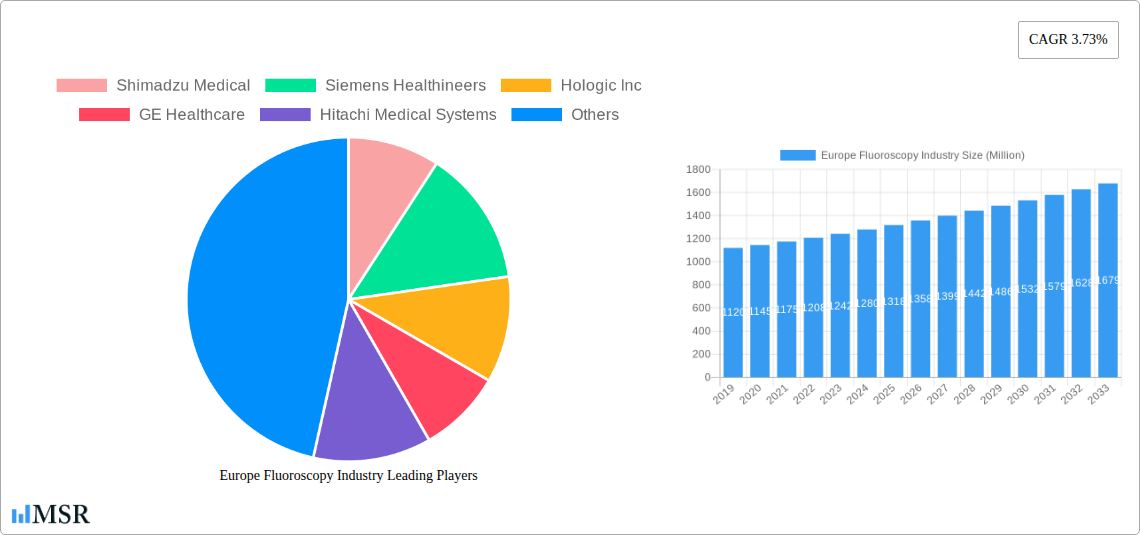
Europe Fluoroscopy Industry Market Size (In Billion)

The competitive landscape is characterized by the presence of major global players including Siemens Healthineers, GE Healthcare, Philips, and Canon Medical Systems Corporation, alongside specialized manufacturers like Shimadzu Medical and Hologic Inc. These companies are actively investing in research and development to introduce innovative fluoroscopy systems with enhanced imaging capabilities, reduced radiation exposure, and integrated software solutions. While market growth is substantial, certain restraints, such as stringent regulatory approvals and the high initial cost of advanced fluoroscopy equipment, may present challenges. However, the ongoing focus on improving healthcare infrastructure, increasing healthcare expenditure, and the rising adoption of advanced diagnostic tools across major European economies like Germany, the United Kingdom, and France are expected to sustain the market's upward trajectory. The market is segmented by device type, with a healthy demand for both fixed and mobile fluoroscopes, catering to diverse clinical needs and hospital budgets.
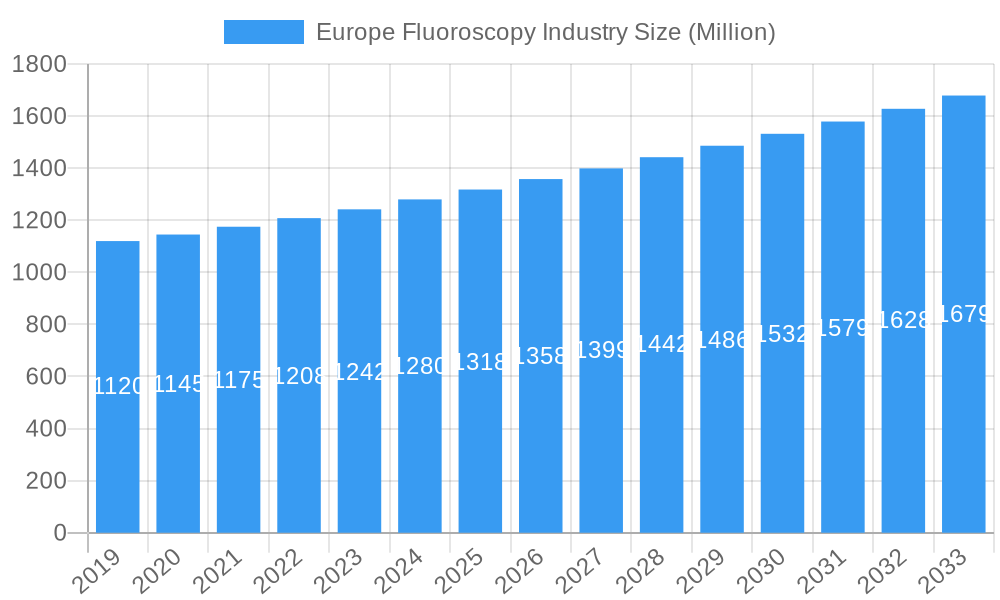
Europe Fluoroscopy Industry Company Market Share
Europe Fluoroscopy Industry Market Overview: Driving Innovation in Medical Imaging
This comprehensive report delves into the dynamic Europe Fluoroscopy Industry, providing in-depth analysis of market size, growth drivers, trends, and competitive landscape. Covering the study period of 2019–2033, with a base year of 2025, this report offers critical insights for stakeholders looking to capitalize on the burgeoning demand for advanced fluoroscopy solutions.
Europe Fluoroscopy Industry Market Concentration & Dynamics
The Europe Fluoroscopy Industry exhibits a moderate level of market concentration, with a handful of key players dominating the landscape. Innovation ecosystems are thriving, fueled by significant R&D investments from leading companies. Regulatory frameworks, such as those established by the European Medicines Agency (EMA) and national competent authorities, play a crucial role in shaping market access and product development. Substitute products, primarily advanced imaging modalities like CT and MRI, present a competitive challenge, though fluoroscopy maintains its indispensable role in real-time imaging for interventional procedures. End-user trends are leaning towards minimally invasive techniques, driving demand for high-resolution, mobile fluoroscopy systems. Mergers and acquisitions (M&A) activities are indicative of strategic consolidation, with an estimated xx M&A deal count in the historical period. Market share is distributed, with major players holding significant portions, necessitating strategic differentiation for emerging entities.
- Market Concentration: Moderate, with key players like Siemens Healthineers and GE Healthcare leading.
- Innovation Ecosystems: Robust, driven by technological advancements in digital radiography and image processing.
- Regulatory Frameworks: Stringent yet supportive of innovation, impacting product approvals and market entry.
- Substitute Products: Advanced CT and MRI technologies, posing competitive pressure.
- End-User Trends: Increasing adoption of minimally invasive procedures.
- M&A Activities: Strategic consolidation and partnerships are observed.
Europe Fluoroscopy Industry Industry Insights & Trends
The Europe Fluoroscopy Industry is poised for significant growth, driven by an increasing prevalence of chronic diseases, an aging population, and the rising demand for minimally invasive diagnostic and therapeutic procedures. The market size is projected to reach approximately XXX Million in 2025, with an estimated Compound Annual Growth Rate (CAGR) of XX% during the forecast period of 2025–2033. Technological disruptions are at the forefront, with advancements in detector technology, image processing software, and artificial intelligence (AI) integration revolutionizing fluoroscopy capabilities. The adoption of digital radiography and the transition from analog to digital systems have enhanced image quality, reduced radiation exposure, and improved workflow efficiency. Evolving consumer behaviors, particularly the growing preference for outpatient procedures and same-day surgeries, are further fueling the demand for advanced, portable, and user-friendly fluoroscopy equipment. The integration of AI for image enhancement, workflow optimization, and potential diagnostic assistance is a key trend shaping the future of fluoroscopy. Furthermore, the increasing focus on radiation dose reduction technologies and patient safety protocols is a significant market driver. The growing number of interventional radiology procedures across various medical specialties, including cardiology, orthopedics, and oncology, underpins the sustained demand for high-performance fluoroscopy systems. The expansion of healthcare infrastructure in emerging economies within Europe also contributes to market expansion.
Key Markets & Segments Leading Europe Fluoroscopy Industry
The Europe Fluoroscopy Industry is characterized by the dominance of specific regions and segments, driven by a confluence of economic, demographic, and technological factors.
Dominant Region: Western European countries, including Germany, France, the United Kingdom, and Italy, currently hold the largest market share due to advanced healthcare infrastructure, high disposable incomes, and a strong emphasis on technological adoption.
Dominant Device Type:
- Fixed Fluoroscopes: These systems remain a cornerstone in hospital settings, particularly for specialized interventional suites, owing to their robust imaging capabilities and integration with other medical equipment. Their dominance is driven by the need for high-resolution, stable imaging in complex procedures.
- Mobile Fluoroscopes: This segment is experiencing substantial growth, particularly:
- Full-size Fluoroscopes: These offer flexibility and portability, enabling their use across various departments and operating rooms, making them ideal for orthopedic surgeries and pain management procedures.
- Mini Fluoroscopes: Increasingly popular for point-of-care diagnostics and niche applications like dental and extremity imaging, their compact size and cost-effectiveness are key drivers.
Dominant Applications:
- Orthopedic: This segment leads due to the high volume of procedures such as fracture reduction, joint replacement surgeries, and spinal interventions, where real-time imaging is crucial for accurate placement and monitoring.
- Cardiovascular: While interventional cardiology procedures are highly demanding, requiring sophisticated angiography systems, fluoroscopy plays a vital role in guidance and visualization.
- Pain Management and Trauma: The increasing incidence of chronic pain and traumatic injuries necessitates the use of fluoroscopy for minimally invasive interventions like epidural injections and fracture fixation.
- Gastrointestinal: Endoscopic retrograde cholangiopancreatography (ERCP) and other GI interventions rely heavily on fluoroscopic guidance.
Drivers for Segment Dominance:
- Economic Growth: Robust economies support higher healthcare spending and adoption of advanced medical technologies.
- Infrastructure Development: Well-established hospitals and clinics with advanced imaging facilities.
- Aging Population: Increased incidence of orthopedic conditions and age-related diseases.
- Technological Advancements: Development of smaller, more precise, and radiation-efficient fluoroscopy devices.
- Minimally Invasive Surgery Trend: Growing preference for less invasive procedures requiring real-time imaging.
Europe Fluoroscopy Industry Product Developments
Product innovations in the Europe Fluoroscopy Industry are focused on enhancing imaging quality, reducing radiation dose, and improving workflow efficiency. Companies are developing systems with higher resolution detectors, advanced image processing algorithms, and AI-powered features for automated image optimization and enhanced diagnostic capabilities. The integration of hybrid imaging solutions, combining fluoroscopy with other modalities, is also a key area of development. Furthermore, the miniaturization of mobile fluoroscopy units is expanding their application in diverse clinical settings, from operating rooms to outpatient clinics, offering greater procedural flexibility and patient comfort. These advancements are crucial for maintaining a competitive edge and addressing the evolving needs of healthcare providers and patients.
Challenges in the Europe Fluoroscopy Industry Market
The Europe Fluoroscopy Industry faces several challenges, including stringent regulatory approval processes that can delay market entry and increase development costs. Supply chain disruptions, particularly for specialized components, can impact production timelines and availability. Intense competitive pressure from both established players and emerging technologies necessitates continuous innovation and cost-effective solutions. The high initial investment cost for advanced fluoroscopy systems can also be a barrier for smaller healthcare facilities.
Forces Driving Europe Fluoroscopy Industry Growth
Several key forces are propelling the growth of the Europe Fluoroscopy Industry. Technological advancements, such as the development of digital flat-panel detectors, improved image processing, and AI integration, are enhancing diagnostic accuracy and patient outcomes. The growing prevalence of chronic diseases and an aging population are leading to an increased demand for interventional procedures, which heavily rely on fluoroscopy. Furthermore, government initiatives promoting advanced healthcare infrastructure and the shift towards minimally invasive surgical techniques are significant growth catalysts.
Challenges in the Europe Fluoroscopy Industry Market
While the outlook is positive, the Europe Fluoroscopy Industry navigates several hurdles. Stringent regulatory requirements across different European nations can create complexity in market access. The need for continuous investment in R&D to keep pace with technological advancements poses a financial challenge. Moreover, the increasing demand for sophisticated, high-end systems necessitates significant capital expenditure, which can be a barrier for some healthcare providers. The potential for job displacement due to automation and the need for skilled professionals to operate advanced equipment are also considerations.
Emerging Opportunities in Europe Fluoroscopy Industry
Emerging opportunities in the Europe Fluoroscopy Industry lie in the expansion of minimally invasive procedures, particularly in orthopedics, pain management, and interventional radiology. The development of advanced AI-powered solutions for image analysis and workflow optimization presents a significant growth avenue. Furthermore, the increasing demand for mobile and compact fluoroscopy systems for use in smaller clinics and remote areas offers new market penetration possibilities. The growing focus on radiation dose reduction technologies and personalized medicine creates opportunities for innovative product development.
Leading Players in the Europe Fluoroscopy Industry Sector
- Shimadzu Medical
- Siemens Healthineers
- Hologic Inc
- GE Healthcare
- Hitachi Medical Systems
- Orthoscan Inc.
- Varian Medical Systems Inc.
- Carestream Health
- Koninklijke Philips NV
- Canon Medical Systems Corporation
Key Milestones in Europe Fluoroscopy Industry Industry
- 2019: Introduction of AI-powered image enhancement in fluoroscopy systems.
- 2020: Launch of next-generation mobile fluoroscopy units with reduced footprint.
- 2021: Significant advancements in radiation dose reduction technologies adopted by major manufacturers.
- 2022: Increased adoption of hybrid imaging rooms integrating fluoroscopy with other modalities.
- 2023: Regulatory approvals for new applications of fluoroscopy in interventional cardiology and neurology.
- 2024: Growing emphasis on cybersecurity features for connected fluoroscopy systems.
Strategic Outlook for Europe Fluoroscopy Industry Market
The strategic outlook for the Europe Fluoroscopy Industry is highly promising, driven by ongoing technological advancements and a growing demand for minimally invasive interventions. Key growth accelerators include the continued integration of AI for enhanced imaging and workflow efficiency, the development of more compact and versatile mobile fluoroscopy systems, and the expansion of applications in specialized medical fields. Strategic partnerships and collaborations will be crucial for market players to leverage expertise, expand product portfolios, and navigate complex regulatory landscapes. Focusing on value-based healthcare solutions that demonstrate improved patient outcomes and cost-effectiveness will be paramount for sustained success in this evolving market.
Europe Fluoroscopy Industry Segmentation
-
1. Device Type
- 1.1. Fixed Fluoroscopes
-
1.2. Mobile Fluoroscopes
- 1.2.1. Full-size Fluoroscopes
- 1.2.2. Mini Fluoroscopes
-
2. Application
- 2.1. Orthopedic
- 2.2. Cardiovascular
- 2.3. Pain Management and Trauma
- 2.4. Neurology
- 2.5. Gastrointestinal
- 2.6. Urology
- 2.7. General Surgery
- 2.8. Other Applications
Europe Fluoroscopy Industry Segmentation By Geography
-
1. Europe
- 1.1. Germany
- 1.2. United Kingdom
- 1.3. France
- 1.4. Italy
- 1.5. Spain
- 1.6. Rest of Europe
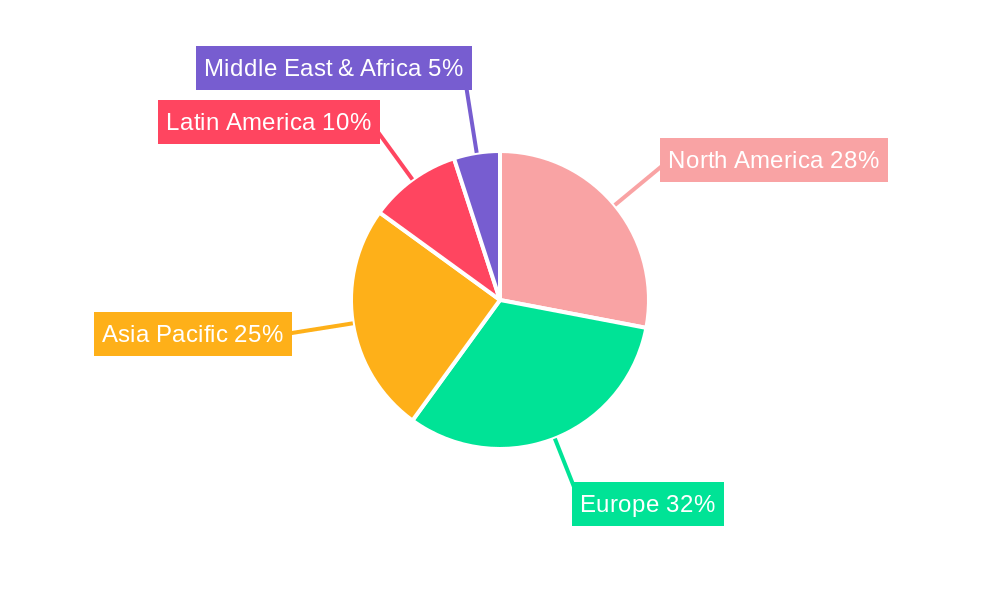
Europe Fluoroscopy Industry Regional Market Share
Geographic Coverage of Europe Fluoroscopy Industry
Europe Fluoroscopy Industry REPORT HIGHLIGHTS
| Aspects | Details |
|---|---|
| Study Period | 2020-2034 |
| Base Year | 2025 |
| Estimated Year | 2026 |
| Forecast Period | 2026-2034 |
| Historical Period | 2020-2025 |
| Growth Rate | CAGR of 3.73% from 2020-2034 |
| Segmentation |
|
Table of Contents
- 1. Introduction
- 1.1. Research Scope
- 1.2. Market Segmentation
- 1.3. Research Methodology
- 1.4. Definitions and Assumptions
- 2. Executive Summary
- 2.1. Introduction
- 3. Market Dynamics
- 3.1. Introduction
- 3.2. Market Drivers
- 3.2.1. Rising Demand for Minimally-invasive Surgeries; Growing Geriatric Population and Prevalence of Chronic Diseases; Increasing Use of Fluoroscopy in Pain Management
- 3.3. Market Restrains
- 3.3.1. Side Effects and Radiation Exposure; Rising Adoption of Refurbished Systems
- 3.4. Market Trends
- 3.4.1. Cardiovascular Application is expected to Cover a Large Share of the Market
- 4. Market Factor Analysis
- 4.1. Porters Five Forces
- 4.2. Supply/Value Chain
- 4.3. PESTEL analysis
- 4.4. Market Entropy
- 4.5. Patent/Trademark Analysis
- 5. Europe Fluoroscopy Industry Analysis, Insights and Forecast, 2020-2032
- 5.1. Market Analysis, Insights and Forecast - by Device Type
- 5.1.1. Fixed Fluoroscopes
- 5.1.2. Mobile Fluoroscopes
- 5.1.2.1. Full-size Fluoroscopes
- 5.1.2.2. Mini Fluoroscopes
- 5.2. Market Analysis, Insights and Forecast - by Application
- 5.2.1. Orthopedic
- 5.2.2. Cardiovascular
- 5.2.3. Pain Management and Trauma
- 5.2.4. Neurology
- 5.2.5. Gastrointestinal
- 5.2.6. Urology
- 5.2.7. General Surgery
- 5.2.8. Other Applications
- 5.3. Market Analysis, Insights and Forecast - by Region
- 5.3.1. Europe
- 5.1. Market Analysis, Insights and Forecast - by Device Type
- 6. Germany Europe Fluoroscopy Industry Analysis, Insights and Forecast, 2020-2032
- 7. France Europe Fluoroscopy Industry Analysis, Insights and Forecast, 2020-2032
- 8. Italy Europe Fluoroscopy Industry Analysis, Insights and Forecast, 2020-2032
- 9. United Kingdom Europe Fluoroscopy Industry Analysis, Insights and Forecast, 2020-2032
- 10. Netherlands Europe Fluoroscopy Industry Analysis, Insights and Forecast, 2020-2032
- 11. Sweden Europe Fluoroscopy Industry Analysis, Insights and Forecast, 2020-2032
- 12. Rest of Europe Europe Fluoroscopy Industry Analysis, Insights and Forecast, 2020-2032
- 13. Competitive Analysis
- 13.1. Market Share Analysis 2025
- 13.2. Company Profiles
- 13.2.1 Shimadzu Medical
- 13.2.1.1. Overview
- 13.2.1.2. Products
- 13.2.1.3. SWOT Analysis
- 13.2.1.4. Recent Developments
- 13.2.1.5. Financials (Based on Availability)
- 13.2.2 Siemens Healthineers
- 13.2.2.1. Overview
- 13.2.2.2. Products
- 13.2.2.3. SWOT Analysis
- 13.2.2.4. Recent Developments
- 13.2.2.5. Financials (Based on Availability)
- 13.2.3 Hologic Inc
- 13.2.3.1. Overview
- 13.2.3.2. Products
- 13.2.3.3. SWOT Analysis
- 13.2.3.4. Recent Developments
- 13.2.3.5. Financials (Based on Availability)
- 13.2.4 GE Healthcare
- 13.2.4.1. Overview
- 13.2.4.2. Products
- 13.2.4.3. SWOT Analysis
- 13.2.4.4. Recent Developments
- 13.2.4.5. Financials (Based on Availability)
- 13.2.5 Hitachi Medical Systems
- 13.2.5.1. Overview
- 13.2.5.2. Products
- 13.2.5.3. SWOT Analysis
- 13.2.5.4. Recent Developments
- 13.2.5.5. Financials (Based on Availability)
- 13.2.6 Orthoscan Inc.
- 13.2.6.1. Overview
- 13.2.6.2. Products
- 13.2.6.3. SWOT Analysis
- 13.2.6.4. Recent Developments
- 13.2.6.5. Financials (Based on Availability)
- 13.2.7 Varian Medical Systems Inc.
- 13.2.7.1. Overview
- 13.2.7.2. Products
- 13.2.7.3. SWOT Analysis
- 13.2.7.4. Recent Developments
- 13.2.7.5. Financials (Based on Availability)
- 13.2.8 Carestream Health
- 13.2.8.1. Overview
- 13.2.8.2. Products
- 13.2.8.3. SWOT Analysis
- 13.2.8.4. Recent Developments
- 13.2.8.5. Financials (Based on Availability)
- 13.2.9 Koninklijke Philips NV
- 13.2.9.1. Overview
- 13.2.9.2. Products
- 13.2.9.3. SWOT Analysis
- 13.2.9.4. Recent Developments
- 13.2.9.5. Financials (Based on Availability)
- 13.2.10 Canon Medical Systems Corporation
- 13.2.10.1. Overview
- 13.2.10.2. Products
- 13.2.10.3. SWOT Analysis
- 13.2.10.4. Recent Developments
- 13.2.10.5. Financials (Based on Availability)
- 13.2.1 Shimadzu Medical
List of Figures
- Figure 1: Europe Fluoroscopy Industry Revenue Breakdown (Million, %) by Product 2025 & 2033
- Figure 2: Europe Fluoroscopy Industry Share (%) by Company 2025
List of Tables
- Table 1: Europe Fluoroscopy Industry Revenue Million Forecast, by Region 2020 & 2033
- Table 2: Europe Fluoroscopy Industry Revenue Million Forecast, by Device Type 2020 & 2033
- Table 3: Europe Fluoroscopy Industry Revenue Million Forecast, by Application 2020 & 2033
- Table 4: Europe Fluoroscopy Industry Revenue Million Forecast, by Region 2020 & 2033
- Table 5: Europe Fluoroscopy Industry Revenue Million Forecast, by Country 2020 & 2033
- Table 6: Germany Europe Fluoroscopy Industry Revenue (Million) Forecast, by Application 2020 & 2033
- Table 7: France Europe Fluoroscopy Industry Revenue (Million) Forecast, by Application 2020 & 2033
- Table 8: Italy Europe Fluoroscopy Industry Revenue (Million) Forecast, by Application 2020 & 2033
- Table 9: United Kingdom Europe Fluoroscopy Industry Revenue (Million) Forecast, by Application 2020 & 2033
- Table 10: Netherlands Europe Fluoroscopy Industry Revenue (Million) Forecast, by Application 2020 & 2033
- Table 11: Sweden Europe Fluoroscopy Industry Revenue (Million) Forecast, by Application 2020 & 2033
- Table 12: Rest of Europe Europe Fluoroscopy Industry Revenue (Million) Forecast, by Application 2020 & 2033
- Table 13: Europe Fluoroscopy Industry Revenue Million Forecast, by Device Type 2020 & 2033
- Table 14: Europe Fluoroscopy Industry Revenue Million Forecast, by Application 2020 & 2033
- Table 15: Europe Fluoroscopy Industry Revenue Million Forecast, by Country 2020 & 2033
- Table 16: Germany Europe Fluoroscopy Industry Revenue (Million) Forecast, by Application 2020 & 2033
- Table 17: United Kingdom Europe Fluoroscopy Industry Revenue (Million) Forecast, by Application 2020 & 2033
- Table 18: France Europe Fluoroscopy Industry Revenue (Million) Forecast, by Application 2020 & 2033
- Table 19: Italy Europe Fluoroscopy Industry Revenue (Million) Forecast, by Application 2020 & 2033
- Table 20: Spain Europe Fluoroscopy Industry Revenue (Million) Forecast, by Application 2020 & 2033
- Table 21: Rest of Europe Europe Fluoroscopy Industry Revenue (Million) Forecast, by Application 2020 & 2033
Frequently Asked Questions
1. What is the projected Compound Annual Growth Rate (CAGR) of the Europe Fluoroscopy Industry?
The projected CAGR is approximately 3.73%.
2. Which companies are prominent players in the Europe Fluoroscopy Industry?
Key companies in the market include Shimadzu Medical, Siemens Healthineers, Hologic Inc, GE Healthcare, Hitachi Medical Systems, Orthoscan Inc., Varian Medical Systems Inc., Carestream Health, Koninklijke Philips NV, Canon Medical Systems Corporation.
3. What are the main segments of the Europe Fluoroscopy Industry?
The market segments include Device Type, Application.
4. Can you provide details about the market size?
The market size is estimated to be USD 1.38 Million as of 2022.
5. What are some drivers contributing to market growth?
Rising Demand for Minimally-invasive Surgeries; Growing Geriatric Population and Prevalence of Chronic Diseases; Increasing Use of Fluoroscopy in Pain Management.
6. What are the notable trends driving market growth?
Cardiovascular Application is expected to Cover a Large Share of the Market.
7. Are there any restraints impacting market growth?
Side Effects and Radiation Exposure; Rising Adoption of Refurbished Systems.
8. Can you provide examples of recent developments in the market?
N/A
9. What pricing options are available for accessing the report?
Pricing options include single-user, multi-user, and enterprise licenses priced at USD 4750, USD 5250, and USD 8750 respectively.
10. Is the market size provided in terms of value or volume?
The market size is provided in terms of value, measured in Million.
11. Are there any specific market keywords associated with the report?
Yes, the market keyword associated with the report is "Europe Fluoroscopy Industry," which aids in identifying and referencing the specific market segment covered.
12. How do I determine which pricing option suits my needs best?
The pricing options vary based on user requirements and access needs. Individual users may opt for single-user licenses, while businesses requiring broader access may choose multi-user or enterprise licenses for cost-effective access to the report.
13. Are there any additional resources or data provided in the Europe Fluoroscopy Industry report?
While the report offers comprehensive insights, it's advisable to review the specific contents or supplementary materials provided to ascertain if additional resources or data are available.
14. How can I stay updated on further developments or reports in the Europe Fluoroscopy Industry?
To stay informed about further developments, trends, and reports in the Europe Fluoroscopy Industry, consider subscribing to industry newsletters, following relevant companies and organizations, or regularly checking reputable industry news sources and publications.
Methodology
Step 1 - Identification of Relevant Samples Size from Population Database



Step 2 - Approaches for Defining Global Market Size (Value, Volume* & Price*)

Note*: In applicable scenarios
Step 3 - Data Sources
Primary Research
- Web Analytics
- Survey Reports
- Research Institute
- Latest Research Reports
- Opinion Leaders
Secondary Research
- Annual Reports
- White Paper
- Latest Press Release
- Industry Association
- Paid Database
- Investor Presentations

Step 4 - Data Triangulation
Involves using different sources of information in order to increase the validity of a study
These sources are likely to be stakeholders in a program - participants, other researchers, program staff, other community members, and so on.
Then we put all data in single framework & apply various statistical tools to find out the dynamic on the market.
During the analysis stage, feedback from the stakeholder groups would be compared to determine areas of agreement as well as areas of divergence
