

Key Insights
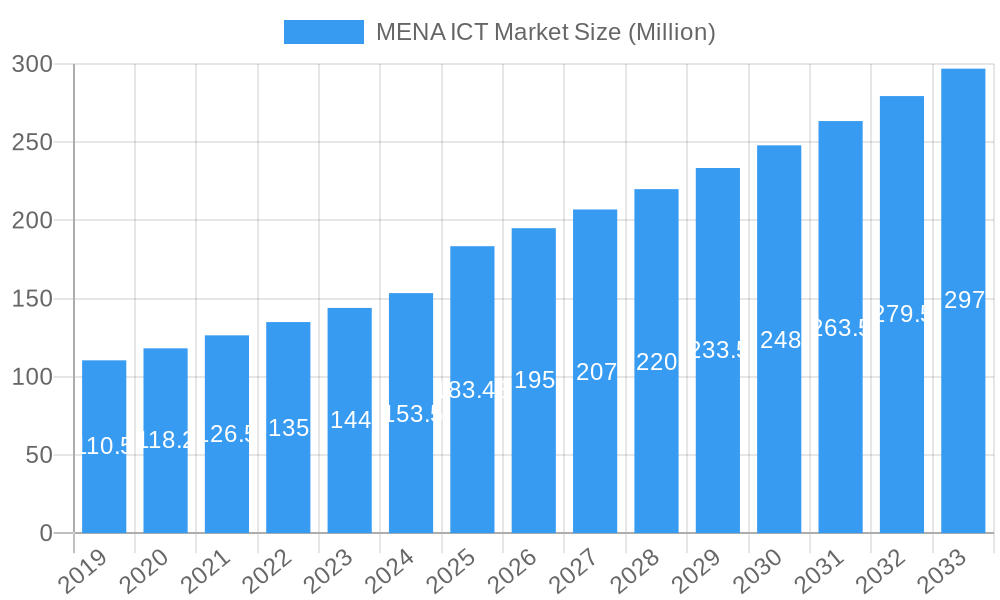
The Middle East and North Africa (MENA) ICT market is poised for significant expansion, projected to reach an impressive $183.48 million by 2025, exhibiting a robust Compound Annual Growth Rate (CAGR) of 6.41% during the forecast period of 2025-2033. This growth is primarily fueled by the escalating adoption of advanced technologies such as Big Data Analytics, Cloud Computing, and Mobility and Telecom solutions, which are revolutionizing business processes across various sectors. Key drivers include substantial government initiatives aimed at digital transformation, a burgeoning young and tech-savvy population, and increasing investments in smart city projects and digital infrastructure development across the region. The market's expansion is also supported by the growing demand for Business Process Outsourcing (BPO) services, as organizations seek to optimize operations and leverage specialized expertise. Furthermore, advancements in hardware and software, coupled with enhanced communication and connectivity, are creating a fertile ground for innovation and market penetration.
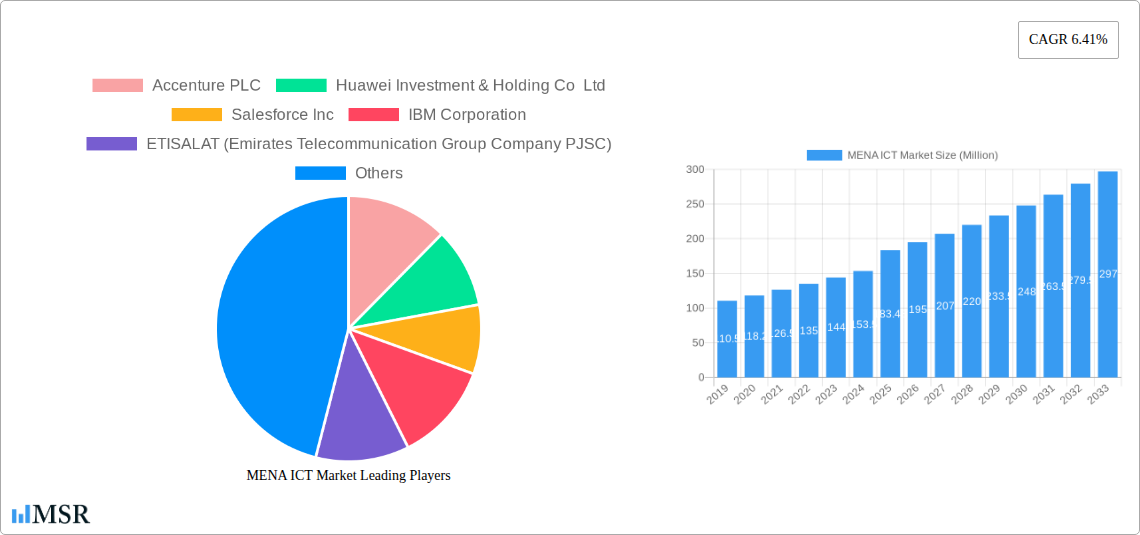
MENA ICT Market Market Size (In Million)

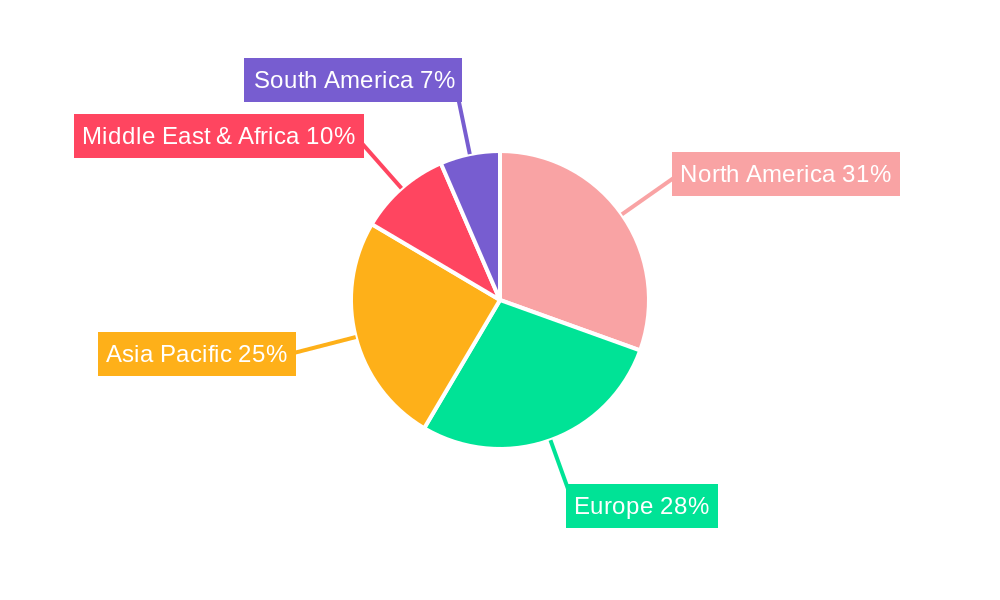
While the ICT landscape in MENA is brimming with opportunities, certain restraints could influence the pace of growth. These include challenges related to cybersecurity threats, data privacy concerns, and the need for a skilled workforce to manage and implement complex technological solutions. However, proactive measures by governments and private entities to address these issues through robust regulatory frameworks and training programs are mitigating these risks. The market is segmented across various technologies, components, and end-user industries, with notable contributions from Financial Services, Healthcare, and Oil, Gas, and Utilities sectors. Geographically, North America, Europe, and Asia Pacific are leading the charge in terms of market share, with a strong presence of major ICT players like Accenture, Huawei, Salesforce, IBM, and Google, all actively contributing to the region's digital evolution and competitiveness.
MENA ICT Market Company Market Share
Unlock the potential of the Middle East and North Africa (MENA) Information and Communications Technology (ICT) market with this definitive report. Spanning from 2019 to 2033, with a base and estimated year of 2025 and a forecast period of 2025–2033, this analysis delves deep into the dynamic and rapidly evolving ICT landscape across the MENA region. We provide granular insights into Big Data Analytics, Mobility and Telecom, Cloud Computing, Storage, Business Process Outsourcing, and Other Technologies. Our examination extends to the crucial Hardware/Devices, Software and Services, and Communication and Connectivity components, alongside their impact on vital end-user industries such as Oil, Gas and Utilities, Travel and Hospitality, Healthcare, Financial Services, Manufacturing and Construction, and Other End-user Industries. This report is an essential resource for industry stakeholders, investors, and policymakers seeking to navigate and capitalize on the immense opportunities within the MENA ICT sector.
MENA ICT Market Market Concentration & Dynamics
The MENA ICT market exhibits a moderate to high concentration, driven by a few dominant global players and an increasing number of agile regional innovators. Innovation ecosystems are flourishing, particularly in hubs like Dubai and Riyadh, fostering advancements in cloud computing and AI. Regulatory frameworks are progressively evolving to support digital transformation initiatives, encouraging foreign investment and local technological development. Substitute products are emerging, especially in the Software as a Service (SaaS) space, challenging traditional on-premise solutions. End-user trends highlight a strong demand for digital services, cloud adoption, and advanced analytics across all sectors. Mergers and acquisitions (M&A) activities are on the rise as larger companies seek to expand their regional footprint and acquire specialized technologies. M&A deal counts have seen a steady increase of approximately 15% year-on-year. Key players like Huawei Investment & Holding Co Ltd and Microsoft Corporation hold significant market share, estimated between 15%-20% in their respective segments. The market is characterized by strategic partnerships and a competitive drive for market leadership, with innovation being a key differentiator.
MENA ICT Market Industry Insights & Trends
The MENA ICT market is experiencing robust growth, propelled by strong government initiatives focused on economic diversification and digital transformation, such as Saudi Vision 2030 and UAE’s Centennial 2071. The market size is projected to reach approximately $150 Billion by 2025, with a Compound Annual Growth Rate (CAGR) of roughly 8.5% during the forecast period. Technological disruptions are a constant, with cloud computing and big data analytics at the forefront, enabling businesses to optimize operations and gain competitive advantages. Evolving consumer behaviors, influenced by increased smartphone penetration and a growing digital-native population, are driving demand for personalized services and seamless online experiences. The adoption of 5G networks is accelerating, paving the way for new applications in the Internet of Things (IoT) and enhanced mobile services. Furthermore, the burgeoning e-commerce sector and the increasing reliance on digital platforms for education and healthcare are significant growth catalysts. The market is also witnessing a surge in demand for cybersecurity solutions, as digital footprints expand and data security becomes paramount. Investment in AI and machine learning is on an upward trajectory, promising to revolutionize various industries through automation and intelligent decision-making.
Key Markets & Segments Leading MENA ICT Market
The MENA ICT market is characterized by the dominance of specific regions and segments, driven by a confluence of economic, technological, and regulatory factors. The United Arab Emirates and Saudi Arabia consistently emerge as leading markets due to substantial government investment in ICT infrastructure and digital transformation agendas.
Technology Segment Dominance:
- Cloud Computing: This segment is a major growth engine, with a market size estimated to reach $30 Billion by 2025.
- Drivers: Increasing demand for scalable and flexible IT solutions, cost optimization initiatives by enterprises, and government support for cloud adoption. Companies like Amazon Web Services (AWS) and Microsoft Corporation are making significant investments.
- Mobility and Telecom: This segment continues its strong performance, driven by the widespread adoption of smartphones and the rollout of 5G networks.
- Drivers: Growing youth population, increasing internet penetration, and the demand for advanced mobile services and connectivity. Huawei Investment & Holding Co Ltd and ETISALAT are key players.
- Big Data Analytics: This segment is rapidly expanding as organizations leverage data for insights and decision-making.
- Drivers: Proliferation of data generated from various digital touchpoints, need for personalized customer experiences, and the drive for operational efficiency. IBM Corporation and Google LLC (Alphabet Inc) are prominent in this space.
Component Segment Dominance:
- Software and Services: This segment is outpacing hardware due to the growing demand for integrated solutions and specialized applications.
- Drivers: Digital transformation initiatives, adoption of cloud-based software, and the need for managed IT services. Salesforce Inc and SAP SE are leading providers.
- Communication and Connectivity: Essential for all digital operations, this segment sees consistent demand.
- Drivers: Expansion of telecommunication networks, increasing data traffic, and the need for reliable connectivity for businesses and consumers. Cisco Systems Inc plays a vital role here.
End-user Industry Dominance:
- Financial Services: This sector is a significant adopter of ICT solutions, driven by digital banking, FinTech innovation, and the need for robust security.
- Drivers: Growing demand for online banking, mobile payments, and regulatory compliance driving technology investments. Oracle Corporation is a key technology partner.
- Oil, Gas and Utilities: This industry is increasingly investing in smart technologies for operational efficiency, safety, and sustainability.
- Drivers: Digitalization of operational processes, IoT applications for asset management, and data analytics for predictive maintenance. Accenture PLC provides extensive consulting and implementation services.
MENA ICT Market Product Developments
Recent product developments in the MENA ICT market underscore a strong focus on intelligent automation, cloud-native solutions, and enhanced connectivity. Companies are introducing advanced AI-powered platforms for business process automation, enabling organizations to streamline operations and improve efficiency. The integration of 5G capabilities into a wider range of devices and services is a key trend, facilitating real-time data processing and enabling new applications in areas like smart cities and industrial IoT. Furthermore, there's a growing emphasis on cybersecurity solutions that offer proactive threat detection and response, crucial for protecting sensitive data in an increasingly interconnected environment. Innovations in data analytics tools are empowering businesses to derive deeper insights from their vast datasets, leading to more informed strategic decisions.
Challenges in the MENA ICT Market Market
Despite its promising growth, the MENA ICT market faces several challenges. Regulatory fragmentation across different countries can create hurdles for market entry and expansion. A significant skills gap in specialized ICT fields, such as AI and cybersecurity, limits the pace of adoption and innovation. High initial investment costs for advanced technologies can be a barrier for some small and medium-sized enterprises (SMEs). Moreover, geopolitical uncertainties and varying economic conditions across the region can impact investment decisions. The need for robust cybersecurity infrastructure to combat sophisticated cyber threats remains a continuous challenge.
Forces Driving MENA ICT Market Growth
Several powerful forces are propelling the MENA ICT market forward. Ambitious government visions for digital economies are a primary driver, leading to substantial public and private sector investment in technology infrastructure and digital services. The rapidly growing young population, coupled with increasing digital literacy, fuels demand for innovative ICT solutions. The continuous expansion of broadband and mobile network coverage, particularly the widespread adoption of 5G, is creating new opportunities for advanced applications and services. Furthermore, the ongoing digital transformation across key industries like financial services and healthcare is necessitating increased ICT spending. The increasing focus on cybersecurity and data privacy regulations is also driving investment in robust security solutions.
Challenges in the MENA ICT Market Market
The MENA ICT market is poised for sustained long-term growth, fueled by several key catalysts. The ongoing digital transformation across all sectors, from government services to retail, will continue to drive demand for cloud computing, AI, and big data solutions. Strategic partnerships and collaborations between global technology giants and regional players are fostering innovation and accelerating market penetration. The continuous expansion of e-commerce and digital payment ecosystems will further boost the reliance on robust ICT infrastructure. Furthermore, the increasing adoption of smart city initiatives and the development of digital infrastructure in emerging economies within the region present significant growth opportunities.
Emerging Opportunities in MENA ICT Market
Emerging opportunities in the MENA ICT market are abundant and diverse. The growing demand for AI and machine learning applications in sectors like healthcare, finance, and utilities presents a significant growth avenue. The expansion of IoT deployments for smart homes, smart cities, and industrial automation offers substantial potential. The increasing focus on sustainable technology solutions and green ICT practices also represents a nascent but growing opportunity. Furthermore, the development of localized content and digital services tailored to the region's diverse cultural landscape is a promising area for innovation and market penetration.
Leading Players in the MENA ICT Market Sector
- Accenture PLC
- Huawei Investment & Holding Co Ltd
- Salesforce Inc
- IBM Corporation
- ETISALAT (Emirates Telecommunication Group Company PJSC)
- Google LLC (Alphabet Inc )
- Cisco Systems Inc
- HP Inc
- Microsoft Corporation
- Oracle Corporation
- Amazon Web Services (AWS)
- SAP SE
Key Milestones in MENA ICT Market Industry
- October 2023: Logicom, a regional technology distributor, entered a strategic relationship agreement with HP Poly, a provider of advanced workplace collaboration solutions. These solutions bridge the gap between in-room and remote participants in meetings, enhancing meeting equity. Through this collaboration, Logicom sought to empower its channel partners throughout the extended Middle East, allowing them to deliver HP Poly's advanced remote work as well as office collaboration solutions to their customers. As businesses increasingly adopt flexible work arrangements, this cooperation came at a crucial time to address the rising demand for innovative collaboration solutions that augment remote collaboration and productivity.
- February 2023: Abu Dhabi-based Mohamed bin Zayed University introduced a brand-new AI Center of Excellence backed by the consulting and technology power of IBM. This newly released AI Center of Excellence is a crucial part of MBZUAI's ambition to operate at the lead of the AI domain through continuous upskilling and research. The AI Center of Excellence also possesses an outward focus, assisting businesses and governments by improving the overall adoption of AI technology.
Strategic Outlook for MENA ICT Market Market
The strategic outlook for the MENA ICT market remains exceptionally strong, with continued investment in digital transformation and advanced technologies. Future growth will be accelerated by a focus on cloud-native architectures, the widespread implementation of AI and machine learning for enhanced decision-making, and the continued expansion of 5G connectivity to support IoT and emerging applications. Strategic opportunities lie in addressing the evolving needs of industries such as renewable energy, sustainable agriculture, and personalized healthcare through innovative ICT solutions. The development of regional tech ecosystems and fostering local talent will be crucial for sustained market leadership and competitive advantage.
MENA ICT Market Segmentation
-
1. Technology
- 1.1. Big Data Analytics
- 1.2. Mobility and Telecom
- 1.3. Cloud Computing
- 1.4. Storage
- 1.5. Business Process Outsourcing
- 1.6. Other Technologies
-
2. Component
- 2.1. Hardware/Devices
- 2.2. Software and Services
- 2.3. Communication and Connectivity
-
3. End-user Industry
- 3.1. Oil, Gas and Utilities
- 3.2. Travel and Hospitality
- 3.3. Healthcare
- 3.4. Financial Services
- 3.5. Manufacturing and Construction
- 3.6. Other End-user Industries
MENA ICT Market Segmentation By Geography
-
1. North America
- 1.1. United States
- 1.2. Canada
- 1.3. Mexico
-
2. South America
- 2.1. Brazil
- 2.2. Argentina
- 2.3. Rest of South America
-
3. Europe
- 3.1. United Kingdom
- 3.2. Germany
- 3.3. France
- 3.4. Italy
- 3.5. Spain
- 3.6. Russia
- 3.7. Benelux
- 3.8. Nordics
- 3.9. Rest of Europe
-
4. Middle East & Africa
- 4.1. Turkey
- 4.2. Israel
- 4.3. GCC
- 4.4. North Africa
- 4.5. South Africa
- 4.6. Rest of Middle East & Africa
-
5. Asia Pacific
- 5.1. China
- 5.2. India
- 5.3. Japan
- 5.4. South Korea
- 5.5. ASEAN
- 5.6. Oceania
- 5.7. Rest of Asia Pacific
MENA ICT Market Regional Market Share
Geographic Coverage of MENA ICT Market
MENA ICT Market REPORT HIGHLIGHTS
| Aspects | Details |
|---|---|
| Study Period | 2020-2034 |
| Base Year | 2025 |
| Estimated Year | 2026 |
| Forecast Period | 2026-2034 |
| Historical Period | 2020-2025 |
| Growth Rate | CAGR of 6.41% from 2020-2034 |
| Segmentation |
|
Table of Contents
- 1. Introduction
- 1.1. Research Scope
- 1.2. Market Segmentation
- 1.3. Research Methodology
- 1.4. Definitions and Assumptions
- 2. Executive Summary
- 2.1. Introduction
- 3. Market Dynamics
- 3.1. Introduction
- 3.2. Market Drivers
- 3.2.1. Ongoing Events and Tourism Demanding Automation; Government Policies and PPP Initiatives; Rising Digital Transformation in the Industries
- 3.3. Market Restrains
- 3.3.1. High Risk of Data Theft; Heavy Dependence on Oil and Gas Sector
- 3.4. Market Trends
- 3.4.1. Communication and Connectivity Component to Hold Major Share
- 4. Market Factor Analysis
- 4.1. Porters Five Forces
- 4.2. Supply/Value Chain
- 4.3. PESTEL analysis
- 4.4. Market Entropy
- 4.5. Patent/Trademark Analysis
- 5. Global MENA ICT Market Analysis, Insights and Forecast, 2020-2032
- 5.1. Market Analysis, Insights and Forecast - by Technology
- 5.1.1. Big Data Analytics
- 5.1.2. Mobility and Telecom
- 5.1.3. Cloud Computing
- 5.1.4. Storage
- 5.1.5. Business Process Outsourcing
- 5.1.6. Other Technologies
- 5.2. Market Analysis, Insights and Forecast - by Component
- 5.2.1. Hardware/Devices
- 5.2.2. Software and Services
- 5.2.3. Communication and Connectivity
- 5.3. Market Analysis, Insights and Forecast - by End-user Industry
- 5.3.1. Oil, Gas and Utilities
- 5.3.2. Travel and Hospitality
- 5.3.3. Healthcare
- 5.3.4. Financial Services
- 5.3.5. Manufacturing and Construction
- 5.3.6. Other End-user Industries
- 5.4. Market Analysis, Insights and Forecast - by Region
- 5.4.1. North America
- 5.4.2. South America
- 5.4.3. Europe
- 5.4.4. Middle East & Africa
- 5.4.5. Asia Pacific
- 5.1. Market Analysis, Insights and Forecast - by Technology
- 6. North America MENA ICT Market Analysis, Insights and Forecast, 2020-2032
- 6.1. Market Analysis, Insights and Forecast - by Technology
- 6.1.1. Big Data Analytics
- 6.1.2. Mobility and Telecom
- 6.1.3. Cloud Computing
- 6.1.4. Storage
- 6.1.5. Business Process Outsourcing
- 6.1.6. Other Technologies
- 6.2. Market Analysis, Insights and Forecast - by Component
- 6.2.1. Hardware/Devices
- 6.2.2. Software and Services
- 6.2.3. Communication and Connectivity
- 6.3. Market Analysis, Insights and Forecast - by End-user Industry
- 6.3.1. Oil, Gas and Utilities
- 6.3.2. Travel and Hospitality
- 6.3.3. Healthcare
- 6.3.4. Financial Services
- 6.3.5. Manufacturing and Construction
- 6.3.6. Other End-user Industries
- 6.1. Market Analysis, Insights and Forecast - by Technology
- 7. South America MENA ICT Market Analysis, Insights and Forecast, 2020-2032
- 7.1. Market Analysis, Insights and Forecast - by Technology
- 7.1.1. Big Data Analytics
- 7.1.2. Mobility and Telecom
- 7.1.3. Cloud Computing
- 7.1.4. Storage
- 7.1.5. Business Process Outsourcing
- 7.1.6. Other Technologies
- 7.2. Market Analysis, Insights and Forecast - by Component
- 7.2.1. Hardware/Devices
- 7.2.2. Software and Services
- 7.2.3. Communication and Connectivity
- 7.3. Market Analysis, Insights and Forecast - by End-user Industry
- 7.3.1. Oil, Gas and Utilities
- 7.3.2. Travel and Hospitality
- 7.3.3. Healthcare
- 7.3.4. Financial Services
- 7.3.5. Manufacturing and Construction
- 7.3.6. Other End-user Industries
- 7.1. Market Analysis, Insights and Forecast - by Technology
- 8. Europe MENA ICT Market Analysis, Insights and Forecast, 2020-2032
- 8.1. Market Analysis, Insights and Forecast - by Technology
- 8.1.1. Big Data Analytics
- 8.1.2. Mobility and Telecom
- 8.1.3. Cloud Computing
- 8.1.4. Storage
- 8.1.5. Business Process Outsourcing
- 8.1.6. Other Technologies
- 8.2. Market Analysis, Insights and Forecast - by Component
- 8.2.1. Hardware/Devices
- 8.2.2. Software and Services
- 8.2.3. Communication and Connectivity
- 8.3. Market Analysis, Insights and Forecast - by End-user Industry
- 8.3.1. Oil, Gas and Utilities
- 8.3.2. Travel and Hospitality
- 8.3.3. Healthcare
- 8.3.4. Financial Services
- 8.3.5. Manufacturing and Construction
- 8.3.6. Other End-user Industries
- 8.1. Market Analysis, Insights and Forecast - by Technology
- 9. Middle East & Africa MENA ICT Market Analysis, Insights and Forecast, 2020-2032
- 9.1. Market Analysis, Insights and Forecast - by Technology
- 9.1.1. Big Data Analytics
- 9.1.2. Mobility and Telecom
- 9.1.3. Cloud Computing
- 9.1.4. Storage
- 9.1.5. Business Process Outsourcing
- 9.1.6. Other Technologies
- 9.2. Market Analysis, Insights and Forecast - by Component
- 9.2.1. Hardware/Devices
- 9.2.2. Software and Services
- 9.2.3. Communication and Connectivity
- 9.3. Market Analysis, Insights and Forecast - by End-user Industry
- 9.3.1. Oil, Gas and Utilities
- 9.3.2. Travel and Hospitality
- 9.3.3. Healthcare
- 9.3.4. Financial Services
- 9.3.5. Manufacturing and Construction
- 9.3.6. Other End-user Industries
- 9.1. Market Analysis, Insights and Forecast - by Technology
- 10. Asia Pacific MENA ICT Market Analysis, Insights and Forecast, 2020-2032
- 10.1. Market Analysis, Insights and Forecast - by Technology
- 10.1.1. Big Data Analytics
- 10.1.2. Mobility and Telecom
- 10.1.3. Cloud Computing
- 10.1.4. Storage
- 10.1.5. Business Process Outsourcing
- 10.1.6. Other Technologies
- 10.2. Market Analysis, Insights and Forecast - by Component
- 10.2.1. Hardware/Devices
- 10.2.2. Software and Services
- 10.2.3. Communication and Connectivity
- 10.3. Market Analysis, Insights and Forecast - by End-user Industry
- 10.3.1. Oil, Gas and Utilities
- 10.3.2. Travel and Hospitality
- 10.3.3. Healthcare
- 10.3.4. Financial Services
- 10.3.5. Manufacturing and Construction
- 10.3.6. Other End-user Industries
- 10.1. Market Analysis, Insights and Forecast - by Technology
- 11. North America MENA ICT Market Analysis, Insights and Forecast, 2020-2032
- 11.1. Market Analysis, Insights and Forecast - By Country/Sub-region
- 11.1.1.
- 12. Europe MENA ICT Market Analysis, Insights and Forecast, 2020-2032
- 12.1. Market Analysis, Insights and Forecast - By Country/Sub-region
- 12.1.1.
- 13. Asia Pacific MENA ICT Market Analysis, Insights and Forecast, 2020-2032
- 13.1. Market Analysis, Insights and Forecast - By Country/Sub-region
- 13.1.1.
- 14. Latin America MENA ICT Market Analysis, Insights and Forecast, 2020-2032
- 14.1. Market Analysis, Insights and Forecast - By Country/Sub-region
- 14.1.1.
- 15. Middle East and Africa MENA ICT Market Analysis, Insights and Forecast, 2020-2032
- 15.1. Market Analysis, Insights and Forecast - By Country/Sub-region
- 15.1.1.
- 16. Competitive Analysis
- 16.1. Global Market Share Analysis 2025
- 16.2. Company Profiles
- 16.2.1 Accenture PLC
- 16.2.1.1. Overview
- 16.2.1.2. Products
- 16.2.1.3. SWOT Analysis
- 16.2.1.4. Recent Developments
- 16.2.1.5. Financials (Based on Availability)
- 16.2.2 Huawei Investment & Holding Co Ltd
- 16.2.2.1. Overview
- 16.2.2.2. Products
- 16.2.2.3. SWOT Analysis
- 16.2.2.4. Recent Developments
- 16.2.2.5. Financials (Based on Availability)
- 16.2.3 Salesforce Inc
- 16.2.3.1. Overview
- 16.2.3.2. Products
- 16.2.3.3. SWOT Analysis
- 16.2.3.4. Recent Developments
- 16.2.3.5. Financials (Based on Availability)
- 16.2.4 IBM Corporation
- 16.2.4.1. Overview
- 16.2.4.2. Products
- 16.2.4.3. SWOT Analysis
- 16.2.4.4. Recent Developments
- 16.2.4.5. Financials (Based on Availability)
- 16.2.5 ETISALAT (Emirates Telecommunication Group Company PJSC)
- 16.2.5.1. Overview
- 16.2.5.2. Products
- 16.2.5.3. SWOT Analysis
- 16.2.5.4. Recent Developments
- 16.2.5.5. Financials (Based on Availability)
- 16.2.6 Google LLC (Alphabet Inc )
- 16.2.6.1. Overview
- 16.2.6.2. Products
- 16.2.6.3. SWOT Analysis
- 16.2.6.4. Recent Developments
- 16.2.6.5. Financials (Based on Availability)
- 16.2.7 Cisco Systems Inc
- 16.2.7.1. Overview
- 16.2.7.2. Products
- 16.2.7.3. SWOT Analysis
- 16.2.7.4. Recent Developments
- 16.2.7.5. Financials (Based on Availability)
- 16.2.8 HP Inc
- 16.2.8.1. Overview
- 16.2.8.2. Products
- 16.2.8.3. SWOT Analysis
- 16.2.8.4. Recent Developments
- 16.2.8.5. Financials (Based on Availability)
- 16.2.9 Microsoft Corporation
- 16.2.9.1. Overview
- 16.2.9.2. Products
- 16.2.9.3. SWOT Analysis
- 16.2.9.4. Recent Developments
- 16.2.9.5. Financials (Based on Availability)
- 16.2.10 Oracle Corporation
- 16.2.10.1. Overview
- 16.2.10.2. Products
- 16.2.10.3. SWOT Analysis
- 16.2.10.4. Recent Developments
- 16.2.10.5. Financials (Based on Availability)
- 16.2.11 Amazon Web Services (AWS)
- 16.2.11.1. Overview
- 16.2.11.2. Products
- 16.2.11.3. SWOT Analysis
- 16.2.11.4. Recent Developments
- 16.2.11.5. Financials (Based on Availability)
- 16.2.12 SAP SE
- 16.2.12.1. Overview
- 16.2.12.2. Products
- 16.2.12.3. SWOT Analysis
- 16.2.12.4. Recent Developments
- 16.2.12.5. Financials (Based on Availability)
- 16.2.1 Accenture PLC
List of Figures
- Figure 1: Global MENA ICT Market Revenue Breakdown (Million, %) by Region 2025 & 2033
- Figure 2: Global MENA ICT Market Volume Breakdown (K Unit, %) by Region 2025 & 2033
- Figure 3: North America MENA ICT Market Revenue (Million), by Country 2025 & 2033
- Figure 4: North America MENA ICT Market Volume (K Unit), by Country 2025 & 2033
- Figure 5: North America MENA ICT Market Revenue Share (%), by Country 2025 & 2033
- Figure 6: North America MENA ICT Market Volume Share (%), by Country 2025 & 2033
- Figure 7: Europe MENA ICT Market Revenue (Million), by Country 2025 & 2033
- Figure 8: Europe MENA ICT Market Volume (K Unit), by Country 2025 & 2033
- Figure 9: Europe MENA ICT Market Revenue Share (%), by Country 2025 & 2033
- Figure 10: Europe MENA ICT Market Volume Share (%), by Country 2025 & 2033
- Figure 11: Asia Pacific MENA ICT Market Revenue (Million), by Country 2025 & 2033
- Figure 12: Asia Pacific MENA ICT Market Volume (K Unit), by Country 2025 & 2033
- Figure 13: Asia Pacific MENA ICT Market Revenue Share (%), by Country 2025 & 2033
- Figure 14: Asia Pacific MENA ICT Market Volume Share (%), by Country 2025 & 2033
- Figure 15: Latin America MENA ICT Market Revenue (Million), by Country 2025 & 2033
- Figure 16: Latin America MENA ICT Market Volume (K Unit), by Country 2025 & 2033
- Figure 17: Latin America MENA ICT Market Revenue Share (%), by Country 2025 & 2033
- Figure 18: Latin America MENA ICT Market Volume Share (%), by Country 2025 & 2033
- Figure 19: Middle East and Africa MENA ICT Market Revenue (Million), by Country 2025 & 2033
- Figure 20: Middle East and Africa MENA ICT Market Volume (K Unit), by Country 2025 & 2033
- Figure 21: Middle East and Africa MENA ICT Market Revenue Share (%), by Country 2025 & 2033
- Figure 22: Middle East and Africa MENA ICT Market Volume Share (%), by Country 2025 & 2033
- Figure 23: North America MENA ICT Market Revenue (Million), by Technology 2025 & 2033
- Figure 24: North America MENA ICT Market Volume (K Unit), by Technology 2025 & 2033
- Figure 25: North America MENA ICT Market Revenue Share (%), by Technology 2025 & 2033
- Figure 26: North America MENA ICT Market Volume Share (%), by Technology 2025 & 2033
- Figure 27: North America MENA ICT Market Revenue (Million), by Component 2025 & 2033
- Figure 28: North America MENA ICT Market Volume (K Unit), by Component 2025 & 2033
- Figure 29: North America MENA ICT Market Revenue Share (%), by Component 2025 & 2033
- Figure 30: North America MENA ICT Market Volume Share (%), by Component 2025 & 2033
- Figure 31: North America MENA ICT Market Revenue (Million), by End-user Industry 2025 & 2033
- Figure 32: North America MENA ICT Market Volume (K Unit), by End-user Industry 2025 & 2033
- Figure 33: North America MENA ICT Market Revenue Share (%), by End-user Industry 2025 & 2033
- Figure 34: North America MENA ICT Market Volume Share (%), by End-user Industry 2025 & 2033
- Figure 35: North America MENA ICT Market Revenue (Million), by Country 2025 & 2033
- Figure 36: North America MENA ICT Market Volume (K Unit), by Country 2025 & 2033
- Figure 37: North America MENA ICT Market Revenue Share (%), by Country 2025 & 2033
- Figure 38: North America MENA ICT Market Volume Share (%), by Country 2025 & 2033
- Figure 39: South America MENA ICT Market Revenue (Million), by Technology 2025 & 2033
- Figure 40: South America MENA ICT Market Volume (K Unit), by Technology 2025 & 2033
- Figure 41: South America MENA ICT Market Revenue Share (%), by Technology 2025 & 2033
- Figure 42: South America MENA ICT Market Volume Share (%), by Technology 2025 & 2033
- Figure 43: South America MENA ICT Market Revenue (Million), by Component 2025 & 2033
- Figure 44: South America MENA ICT Market Volume (K Unit), by Component 2025 & 2033
- Figure 45: South America MENA ICT Market Revenue Share (%), by Component 2025 & 2033
- Figure 46: South America MENA ICT Market Volume Share (%), by Component 2025 & 2033
- Figure 47: South America MENA ICT Market Revenue (Million), by End-user Industry 2025 & 2033
- Figure 48: South America MENA ICT Market Volume (K Unit), by End-user Industry 2025 & 2033
- Figure 49: South America MENA ICT Market Revenue Share (%), by End-user Industry 2025 & 2033
- Figure 50: South America MENA ICT Market Volume Share (%), by End-user Industry 2025 & 2033
- Figure 51: South America MENA ICT Market Revenue (Million), by Country 2025 & 2033
- Figure 52: South America MENA ICT Market Volume (K Unit), by Country 2025 & 2033
- Figure 53: South America MENA ICT Market Revenue Share (%), by Country 2025 & 2033
- Figure 54: South America MENA ICT Market Volume Share (%), by Country 2025 & 2033
- Figure 55: Europe MENA ICT Market Revenue (Million), by Technology 2025 & 2033
- Figure 56: Europe MENA ICT Market Volume (K Unit), by Technology 2025 & 2033
- Figure 57: Europe MENA ICT Market Revenue Share (%), by Technology 2025 & 2033
- Figure 58: Europe MENA ICT Market Volume Share (%), by Technology 2025 & 2033
- Figure 59: Europe MENA ICT Market Revenue (Million), by Component 2025 & 2033
- Figure 60: Europe MENA ICT Market Volume (K Unit), by Component 2025 & 2033
- Figure 61: Europe MENA ICT Market Revenue Share (%), by Component 2025 & 2033
- Figure 62: Europe MENA ICT Market Volume Share (%), by Component 2025 & 2033
- Figure 63: Europe MENA ICT Market Revenue (Million), by End-user Industry 2025 & 2033
- Figure 64: Europe MENA ICT Market Volume (K Unit), by End-user Industry 2025 & 2033
- Figure 65: Europe MENA ICT Market Revenue Share (%), by End-user Industry 2025 & 2033
- Figure 66: Europe MENA ICT Market Volume Share (%), by End-user Industry 2025 & 2033
- Figure 67: Europe MENA ICT Market Revenue (Million), by Country 2025 & 2033
- Figure 68: Europe MENA ICT Market Volume (K Unit), by Country 2025 & 2033
- Figure 69: Europe MENA ICT Market Revenue Share (%), by Country 2025 & 2033
- Figure 70: Europe MENA ICT Market Volume Share (%), by Country 2025 & 2033
- Figure 71: Middle East & Africa MENA ICT Market Revenue (Million), by Technology 2025 & 2033
- Figure 72: Middle East & Africa MENA ICT Market Volume (K Unit), by Technology 2025 & 2033
- Figure 73: Middle East & Africa MENA ICT Market Revenue Share (%), by Technology 2025 & 2033
- Figure 74: Middle East & Africa MENA ICT Market Volume Share (%), by Technology 2025 & 2033
- Figure 75: Middle East & Africa MENA ICT Market Revenue (Million), by Component 2025 & 2033
- Figure 76: Middle East & Africa MENA ICT Market Volume (K Unit), by Component 2025 & 2033
- Figure 77: Middle East & Africa MENA ICT Market Revenue Share (%), by Component 2025 & 2033
- Figure 78: Middle East & Africa MENA ICT Market Volume Share (%), by Component 2025 & 2033
- Figure 79: Middle East & Africa MENA ICT Market Revenue (Million), by End-user Industry 2025 & 2033
- Figure 80: Middle East & Africa MENA ICT Market Volume (K Unit), by End-user Industry 2025 & 2033
- Figure 81: Middle East & Africa MENA ICT Market Revenue Share (%), by End-user Industry 2025 & 2033
- Figure 82: Middle East & Africa MENA ICT Market Volume Share (%), by End-user Industry 2025 & 2033
- Figure 83: Middle East & Africa MENA ICT Market Revenue (Million), by Country 2025 & 2033
- Figure 84: Middle East & Africa MENA ICT Market Volume (K Unit), by Country 2025 & 2033
- Figure 85: Middle East & Africa MENA ICT Market Revenue Share (%), by Country 2025 & 2033
- Figure 86: Middle East & Africa MENA ICT Market Volume Share (%), by Country 2025 & 2033
- Figure 87: Asia Pacific MENA ICT Market Revenue (Million), by Technology 2025 & 2033
- Figure 88: Asia Pacific MENA ICT Market Volume (K Unit), by Technology 2025 & 2033
- Figure 89: Asia Pacific MENA ICT Market Revenue Share (%), by Technology 2025 & 2033
- Figure 90: Asia Pacific MENA ICT Market Volume Share (%), by Technology 2025 & 2033
- Figure 91: Asia Pacific MENA ICT Market Revenue (Million), by Component 2025 & 2033
- Figure 92: Asia Pacific MENA ICT Market Volume (K Unit), by Component 2025 & 2033
- Figure 93: Asia Pacific MENA ICT Market Revenue Share (%), by Component 2025 & 2033
- Figure 94: Asia Pacific MENA ICT Market Volume Share (%), by Component 2025 & 2033
- Figure 95: Asia Pacific MENA ICT Market Revenue (Million), by End-user Industry 2025 & 2033
- Figure 96: Asia Pacific MENA ICT Market Volume (K Unit), by End-user Industry 2025 & 2033
- Figure 97: Asia Pacific MENA ICT Market Revenue Share (%), by End-user Industry 2025 & 2033
- Figure 98: Asia Pacific MENA ICT Market Volume Share (%), by End-user Industry 2025 & 2033
- Figure 99: Asia Pacific MENA ICT Market Revenue (Million), by Country 2025 & 2033
- Figure 100: Asia Pacific MENA ICT Market Volume (K Unit), by Country 2025 & 2033
- Figure 101: Asia Pacific MENA ICT Market Revenue Share (%), by Country 2025 & 2033
- Figure 102: Asia Pacific MENA ICT Market Volume Share (%), by Country 2025 & 2033
List of Tables
- Table 1: Global MENA ICT Market Revenue Million Forecast, by Region 2020 & 2033
- Table 2: Global MENA ICT Market Volume K Unit Forecast, by Region 2020 & 2033
- Table 3: Global MENA ICT Market Revenue Million Forecast, by Technology 2020 & 2033
- Table 4: Global MENA ICT Market Volume K Unit Forecast, by Technology 2020 & 2033
- Table 5: Global MENA ICT Market Revenue Million Forecast, by Component 2020 & 2033
- Table 6: Global MENA ICT Market Volume K Unit Forecast, by Component 2020 & 2033
- Table 7: Global MENA ICT Market Revenue Million Forecast, by End-user Industry 2020 & 2033
- Table 8: Global MENA ICT Market Volume K Unit Forecast, by End-user Industry 2020 & 2033
- Table 9: Global MENA ICT Market Revenue Million Forecast, by Region 2020 & 2033
- Table 10: Global MENA ICT Market Volume K Unit Forecast, by Region 2020 & 2033
- Table 11: Global MENA ICT Market Revenue Million Forecast, by Country 2020 & 2033
- Table 12: Global MENA ICT Market Volume K Unit Forecast, by Country 2020 & 2033
- Table 13: MENA ICT Market Revenue (Million) Forecast, by Application 2020 & 2033
- Table 14: MENA ICT Market Volume (K Unit) Forecast, by Application 2020 & 2033
- Table 15: Global MENA ICT Market Revenue Million Forecast, by Country 2020 & 2033
- Table 16: Global MENA ICT Market Volume K Unit Forecast, by Country 2020 & 2033
- Table 17: MENA ICT Market Revenue (Million) Forecast, by Application 2020 & 2033
- Table 18: MENA ICT Market Volume (K Unit) Forecast, by Application 2020 & 2033
- Table 19: Global MENA ICT Market Revenue Million Forecast, by Country 2020 & 2033
- Table 20: Global MENA ICT Market Volume K Unit Forecast, by Country 2020 & 2033
- Table 21: MENA ICT Market Revenue (Million) Forecast, by Application 2020 & 2033
- Table 22: MENA ICT Market Volume (K Unit) Forecast, by Application 2020 & 2033
- Table 23: Global MENA ICT Market Revenue Million Forecast, by Country 2020 & 2033
- Table 24: Global MENA ICT Market Volume K Unit Forecast, by Country 2020 & 2033
- Table 25: MENA ICT Market Revenue (Million) Forecast, by Application 2020 & 2033
- Table 26: MENA ICT Market Volume (K Unit) Forecast, by Application 2020 & 2033
- Table 27: Global MENA ICT Market Revenue Million Forecast, by Country 2020 & 2033
- Table 28: Global MENA ICT Market Volume K Unit Forecast, by Country 2020 & 2033
- Table 29: MENA ICT Market Revenue (Million) Forecast, by Application 2020 & 2033
- Table 30: MENA ICT Market Volume (K Unit) Forecast, by Application 2020 & 2033
- Table 31: Global MENA ICT Market Revenue Million Forecast, by Technology 2020 & 2033
- Table 32: Global MENA ICT Market Volume K Unit Forecast, by Technology 2020 & 2033
- Table 33: Global MENA ICT Market Revenue Million Forecast, by Component 2020 & 2033
- Table 34: Global MENA ICT Market Volume K Unit Forecast, by Component 2020 & 2033
- Table 35: Global MENA ICT Market Revenue Million Forecast, by End-user Industry 2020 & 2033
- Table 36: Global MENA ICT Market Volume K Unit Forecast, by End-user Industry 2020 & 2033
- Table 37: Global MENA ICT Market Revenue Million Forecast, by Country 2020 & 2033
- Table 38: Global MENA ICT Market Volume K Unit Forecast, by Country 2020 & 2033
- Table 39: United States MENA ICT Market Revenue (Million) Forecast, by Application 2020 & 2033
- Table 40: United States MENA ICT Market Volume (K Unit) Forecast, by Application 2020 & 2033
- Table 41: Canada MENA ICT Market Revenue (Million) Forecast, by Application 2020 & 2033
- Table 42: Canada MENA ICT Market Volume (K Unit) Forecast, by Application 2020 & 2033
- Table 43: Mexico MENA ICT Market Revenue (Million) Forecast, by Application 2020 & 2033
- Table 44: Mexico MENA ICT Market Volume (K Unit) Forecast, by Application 2020 & 2033
- Table 45: Global MENA ICT Market Revenue Million Forecast, by Technology 2020 & 2033
- Table 46: Global MENA ICT Market Volume K Unit Forecast, by Technology 2020 & 2033
- Table 47: Global MENA ICT Market Revenue Million Forecast, by Component 2020 & 2033
- Table 48: Global MENA ICT Market Volume K Unit Forecast, by Component 2020 & 2033
- Table 49: Global MENA ICT Market Revenue Million Forecast, by End-user Industry 2020 & 2033
- Table 50: Global MENA ICT Market Volume K Unit Forecast, by End-user Industry 2020 & 2033
- Table 51: Global MENA ICT Market Revenue Million Forecast, by Country 2020 & 2033
- Table 52: Global MENA ICT Market Volume K Unit Forecast, by Country 2020 & 2033
- Table 53: Brazil MENA ICT Market Revenue (Million) Forecast, by Application 2020 & 2033
- Table 54: Brazil MENA ICT Market Volume (K Unit) Forecast, by Application 2020 & 2033
- Table 55: Argentina MENA ICT Market Revenue (Million) Forecast, by Application 2020 & 2033
- Table 56: Argentina MENA ICT Market Volume (K Unit) Forecast, by Application 2020 & 2033
- Table 57: Rest of South America MENA ICT Market Revenue (Million) Forecast, by Application 2020 & 2033
- Table 58: Rest of South America MENA ICT Market Volume (K Unit) Forecast, by Application 2020 & 2033
- Table 59: Global MENA ICT Market Revenue Million Forecast, by Technology 2020 & 2033
- Table 60: Global MENA ICT Market Volume K Unit Forecast, by Technology 2020 & 2033
- Table 61: Global MENA ICT Market Revenue Million Forecast, by Component 2020 & 2033
- Table 62: Global MENA ICT Market Volume K Unit Forecast, by Component 2020 & 2033
- Table 63: Global MENA ICT Market Revenue Million Forecast, by End-user Industry 2020 & 2033
- Table 64: Global MENA ICT Market Volume K Unit Forecast, by End-user Industry 2020 & 2033
- Table 65: Global MENA ICT Market Revenue Million Forecast, by Country 2020 & 2033
- Table 66: Global MENA ICT Market Volume K Unit Forecast, by Country 2020 & 2033
- Table 67: United Kingdom MENA ICT Market Revenue (Million) Forecast, by Application 2020 & 2033
- Table 68: United Kingdom MENA ICT Market Volume (K Unit) Forecast, by Application 2020 & 2033
- Table 69: Germany MENA ICT Market Revenue (Million) Forecast, by Application 2020 & 2033
- Table 70: Germany MENA ICT Market Volume (K Unit) Forecast, by Application 2020 & 2033
- Table 71: France MENA ICT Market Revenue (Million) Forecast, by Application 2020 & 2033
- Table 72: France MENA ICT Market Volume (K Unit) Forecast, by Application 2020 & 2033
- Table 73: Italy MENA ICT Market Revenue (Million) Forecast, by Application 2020 & 2033
- Table 74: Italy MENA ICT Market Volume (K Unit) Forecast, by Application 2020 & 2033
- Table 75: Spain MENA ICT Market Revenue (Million) Forecast, by Application 2020 & 2033
- Table 76: Spain MENA ICT Market Volume (K Unit) Forecast, by Application 2020 & 2033
- Table 77: Russia MENA ICT Market Revenue (Million) Forecast, by Application 2020 & 2033
- Table 78: Russia MENA ICT Market Volume (K Unit) Forecast, by Application 2020 & 2033
- Table 79: Benelux MENA ICT Market Revenue (Million) Forecast, by Application 2020 & 2033
- Table 80: Benelux MENA ICT Market Volume (K Unit) Forecast, by Application 2020 & 2033
- Table 81: Nordics MENA ICT Market Revenue (Million) Forecast, by Application 2020 & 2033
- Table 82: Nordics MENA ICT Market Volume (K Unit) Forecast, by Application 2020 & 2033
- Table 83: Rest of Europe MENA ICT Market Revenue (Million) Forecast, by Application 2020 & 2033
- Table 84: Rest of Europe MENA ICT Market Volume (K Unit) Forecast, by Application 2020 & 2033
- Table 85: Global MENA ICT Market Revenue Million Forecast, by Technology 2020 & 2033
- Table 86: Global MENA ICT Market Volume K Unit Forecast, by Technology 2020 & 2033
- Table 87: Global MENA ICT Market Revenue Million Forecast, by Component 2020 & 2033
- Table 88: Global MENA ICT Market Volume K Unit Forecast, by Component 2020 & 2033
- Table 89: Global MENA ICT Market Revenue Million Forecast, by End-user Industry 2020 & 2033
- Table 90: Global MENA ICT Market Volume K Unit Forecast, by End-user Industry 2020 & 2033
- Table 91: Global MENA ICT Market Revenue Million Forecast, by Country 2020 & 2033
- Table 92: Global MENA ICT Market Volume K Unit Forecast, by Country 2020 & 2033
- Table 93: Turkey MENA ICT Market Revenue (Million) Forecast, by Application 2020 & 2033
- Table 94: Turkey MENA ICT Market Volume (K Unit) Forecast, by Application 2020 & 2033
- Table 95: Israel MENA ICT Market Revenue (Million) Forecast, by Application 2020 & 2033
- Table 96: Israel MENA ICT Market Volume (K Unit) Forecast, by Application 2020 & 2033
- Table 97: GCC MENA ICT Market Revenue (Million) Forecast, by Application 2020 & 2033
- Table 98: GCC MENA ICT Market Volume (K Unit) Forecast, by Application 2020 & 2033
- Table 99: North Africa MENA ICT Market Revenue (Million) Forecast, by Application 2020 & 2033
- Table 100: North Africa MENA ICT Market Volume (K Unit) Forecast, by Application 2020 & 2033
- Table 101: South Africa MENA ICT Market Revenue (Million) Forecast, by Application 2020 & 2033
- Table 102: South Africa MENA ICT Market Volume (K Unit) Forecast, by Application 2020 & 2033
- Table 103: Rest of Middle East & Africa MENA ICT Market Revenue (Million) Forecast, by Application 2020 & 2033
- Table 104: Rest of Middle East & Africa MENA ICT Market Volume (K Unit) Forecast, by Application 2020 & 2033
- Table 105: Global MENA ICT Market Revenue Million Forecast, by Technology 2020 & 2033
- Table 106: Global MENA ICT Market Volume K Unit Forecast, by Technology 2020 & 2033
- Table 107: Global MENA ICT Market Revenue Million Forecast, by Component 2020 & 2033
- Table 108: Global MENA ICT Market Volume K Unit Forecast, by Component 2020 & 2033
- Table 109: Global MENA ICT Market Revenue Million Forecast, by End-user Industry 2020 & 2033
- Table 110: Global MENA ICT Market Volume K Unit Forecast, by End-user Industry 2020 & 2033
- Table 111: Global MENA ICT Market Revenue Million Forecast, by Country 2020 & 2033
- Table 112: Global MENA ICT Market Volume K Unit Forecast, by Country 2020 & 2033
- Table 113: China MENA ICT Market Revenue (Million) Forecast, by Application 2020 & 2033
- Table 114: China MENA ICT Market Volume (K Unit) Forecast, by Application 2020 & 2033
- Table 115: India MENA ICT Market Revenue (Million) Forecast, by Application 2020 & 2033
- Table 116: India MENA ICT Market Volume (K Unit) Forecast, by Application 2020 & 2033
- Table 117: Japan MENA ICT Market Revenue (Million) Forecast, by Application 2020 & 2033
- Table 118: Japan MENA ICT Market Volume (K Unit) Forecast, by Application 2020 & 2033
- Table 119: South Korea MENA ICT Market Revenue (Million) Forecast, by Application 2020 & 2033
- Table 120: South Korea MENA ICT Market Volume (K Unit) Forecast, by Application 2020 & 2033
- Table 121: ASEAN MENA ICT Market Revenue (Million) Forecast, by Application 2020 & 2033
- Table 122: ASEAN MENA ICT Market Volume (K Unit) Forecast, by Application 2020 & 2033
- Table 123: Oceania MENA ICT Market Revenue (Million) Forecast, by Application 2020 & 2033
- Table 124: Oceania MENA ICT Market Volume (K Unit) Forecast, by Application 2020 & 2033
- Table 125: Rest of Asia Pacific MENA ICT Market Revenue (Million) Forecast, by Application 2020 & 2033
- Table 126: Rest of Asia Pacific MENA ICT Market Volume (K Unit) Forecast, by Application 2020 & 2033
Frequently Asked Questions
1. What is the projected Compound Annual Growth Rate (CAGR) of the MENA ICT Market?
The projected CAGR is approximately 6.41%.
2. Which companies are prominent players in the MENA ICT Market?
Key companies in the market include Accenture PLC, Huawei Investment & Holding Co Ltd, Salesforce Inc, IBM Corporation, ETISALAT (Emirates Telecommunication Group Company PJSC), Google LLC (Alphabet Inc ), Cisco Systems Inc, HP Inc, Microsoft Corporation, Oracle Corporation, Amazon Web Services (AWS), SAP SE.
3. What are the main segments of the MENA ICT Market?
The market segments include Technology, Component, End-user Industry.
4. Can you provide details about the market size?
The market size is estimated to be USD 183.48 Million as of 2022.
5. What are some drivers contributing to market growth?
Ongoing Events and Tourism Demanding Automation; Government Policies and PPP Initiatives; Rising Digital Transformation in the Industries.
6. What are the notable trends driving market growth?
Communication and Connectivity Component to Hold Major Share.
7. Are there any restraints impacting market growth?
High Risk of Data Theft; Heavy Dependence on Oil and Gas Sector.
8. Can you provide examples of recent developments in the market?
October 2023 - Logicom, a regional technology distributor, entered a strategic relationship agreement with HP Poly, a provider of advanced workplace collaboration solutions. These solutions bridge the gap between in-room and remote participants in meetings, enhancing meeting equity. Through this collaboration, Logicom sought to empower its channel partners throughout the extended Middle East, allowing them to deliver HP Poly's advanced remote work as well as office collaboration solutions to their customers. As businesses increasingly adopt flexible work arrangements, this cooperation came at a crucial time to address the rising demand for innovative collaboration solutions that augment remote collaboration and productivity.
9. What pricing options are available for accessing the report?
Pricing options include single-user, multi-user, and enterprise licenses priced at USD 3800, USD 4500, and USD 5800 respectively.
10. Is the market size provided in terms of value or volume?
The market size is provided in terms of value, measured in Million and volume, measured in K Unit.
11. Are there any specific market keywords associated with the report?
Yes, the market keyword associated with the report is "MENA ICT Market," which aids in identifying and referencing the specific market segment covered.
12. How do I determine which pricing option suits my needs best?
The pricing options vary based on user requirements and access needs. Individual users may opt for single-user licenses, while businesses requiring broader access may choose multi-user or enterprise licenses for cost-effective access to the report.
13. Are there any additional resources or data provided in the MENA ICT Market report?
While the report offers comprehensive insights, it's advisable to review the specific contents or supplementary materials provided to ascertain if additional resources or data are available.
14. How can I stay updated on further developments or reports in the MENA ICT Market?
To stay informed about further developments, trends, and reports in the MENA ICT Market, consider subscribing to industry newsletters, following relevant companies and organizations, or regularly checking reputable industry news sources and publications.
Methodology
Step 1 - Identification of Relevant Samples Size from Population Database



Step 2 - Approaches for Defining Global Market Size (Value, Volume* & Price*)

Note*: In applicable scenarios
Step 3 - Data Sources
Primary Research
- Web Analytics
- Survey Reports
- Research Institute
- Latest Research Reports
- Opinion Leaders
Secondary Research
- Annual Reports
- White Paper
- Latest Press Release
- Industry Association
- Paid Database
- Investor Presentations

Step 4 - Data Triangulation
Involves using different sources of information in order to increase the validity of a study
These sources are likely to be stakeholders in a program - participants, other researchers, program staff, other community members, and so on.
Then we put all data in single framework & apply various statistical tools to find out the dynamic on the market.
During the analysis stage, feedback from the stakeholder groups would be compared to determine areas of agreement as well as areas of divergence
