


Key Insights
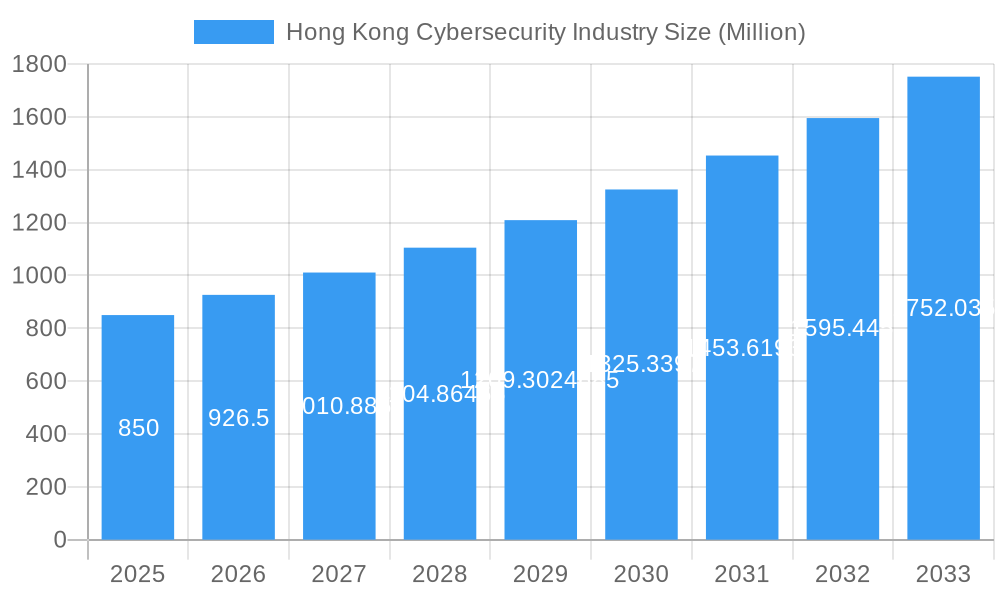
The Hong Kong cybersecurity market is poised for significant expansion, driven by an escalating digital transformation and the increasing sophistication of cyber threats. With a projected market size of USD 0.85 billion in 2025, the industry is set to experience robust growth, propelled by a compound annual growth rate (CAGR) of 9% over the forecast period of 2025-2033. This expansion is fueled by critical drivers such as the burgeoning adoption of cloud-based solutions and the growing demand for advanced data security measures across all sectors. The increasing reliance on digital infrastructure by businesses, coupled with stringent regulatory requirements for data protection, further accentuates the need for comprehensive cybersecurity solutions. Emerging trends like the rise of AI-powered threat detection, the integration of Zero Trust Architecture, and the growing importance of identity and access management are shaping the market's trajectory, creating substantial opportunities for service providers and technology vendors.
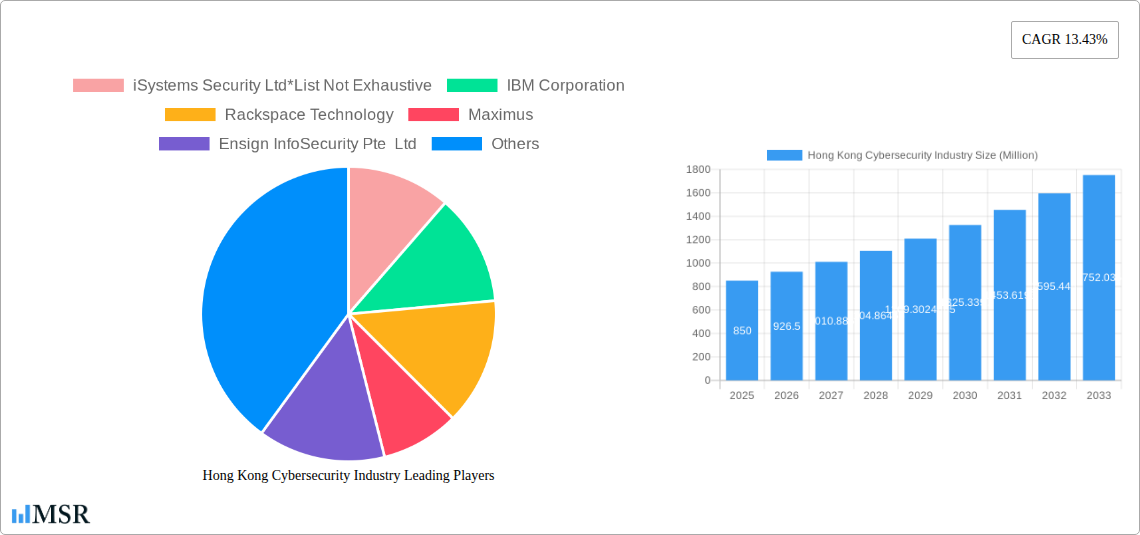
Hong Kong Cybersecurity Industry Market Size (In Million)

Despite this positive outlook, the market faces certain restraints, including the persistent cybersecurity talent shortage and the substantial initial investment required for implementing cutting-edge security systems, which can be a barrier for small and medium-sized enterprises (SMEs). However, the demand for specialized services, particularly in cloud security, data security, and identity access management, is expected to outpace these challenges. Key end-user industries like BFSI, Healthcare, and Government & Defense are anticipated to be major contributors to market growth, owing to their sensitive data assets and the critical nature of their operations. The competitive landscape features a mix of established global players and emerging local enterprises, all vying to offer innovative solutions that address the evolving cyber risk landscape in Hong Kong.
Hong Kong Cybersecurity Industry Company Market Share
Dive deep into the dynamic Hong Kong cybersecurity landscape with this definitive report. Explore market concentration, innovative ecosystems, and the impact of evolving regulatory frameworks on cloud security, data security, and identity access management solutions. Understand how network security advancements and infrastructure protection are shaping the market for BFSI, Healthcare, and Government & Defense sectors. Gain actionable insights into M&A activities, substitute product strategies, and key end-user trends. This report analyzes a market projected to reach billions, offering a critical overview for cybersecurity companies and stakeholders seeking to navigate this rapidly expanding industry.
Hong Kong Cybersecurity Industry Market Concentration & Dynamics
The Hong Kong cybersecurity market exhibits a moderate concentration, driven by a robust influx of both international players and ambitious local enterprises. Innovation ecosystems are thriving, fueled by government initiatives supporting cybersecurity startups and the establishment of dedicated R&D hubs. Regulatory frameworks, particularly those concerning data privacy and cyber threat intelligence, are becoming increasingly stringent, compelling businesses to invest heavily in advanced security solutions. Substitute products, while emerging, often lack the comprehensive protection offered by integrated cybersecurity platforms. End-user trends are heavily influenced by the escalating sophistication of cyber threats, leading to a heightened demand for proactive cyber defense and risk management across all sectors. Mergers and acquisitions (M&A) are a significant dynamic, with an estimated XX deals in the historical period (2019-2024) and an anticipated XX deals during the forecast period (2025-2033), indicating strategic consolidation and expansion by leading cybersecurity providers. Key players are investing in AI-driven security and endpoint protection to gain market share, estimated to be dominated by a few key companies holding over XX% of the market by 2025.
Hong Kong Cybersecurity Industry Industry Insights & Trends
The Hong Kong cybersecurity industry is poised for substantial growth, driven by a confluence of factors that underscore the escalating importance of digital resilience. The market size, estimated to reach USD xx billion in 2025, is projected to expand at a compelling Compound Annual Growth Rate (CAGR) of xx% through 2033. This robust expansion is fueled by the accelerating digital transformation across various sectors, including BFSI, Healthcare, and Government & Defense, all of which are increasingly reliant on sophisticated cybersecurity services to protect sensitive data and critical infrastructure. Technological disruptions, such as the widespread adoption of cloud computing and the proliferation of IoT devices, have created new attack vectors, necessitating continuous innovation in cloud security, data security, and network security. Evolving consumer behaviors, characterized by a greater awareness of cyber threats and a demand for secure online experiences, further bolster the need for advanced consumer security solutions. The integration of artificial intelligence and machine learning into threat detection and incident response platforms represents a significant technological leap, promising more agile and predictive cyber defense mechanisms. Furthermore, the increasing sophistication of nation-state sponsored attacks and organized cybercrime necessitates continuous investment in infrastructure protection and proactive cyber intelligence. The market is also witnessing a shift towards managed security services, as organizations seek to offload complex security operations to specialized cybersecurity companies, thereby optimizing costs and enhancing their overall security posture.
Key Markets & Segments Leading Hong Kong Cybersecurity Industry
The Hong Kong cybersecurity industry is characterized by the dominance of specific segments and end-user industries, reflecting the region's economic strengths and evolving digital landscape.
Dominant Security Types:
- Cloud Security: Driven by the rapid adoption of cloud infrastructure by businesses, cloud security solutions are experiencing exponential demand. This includes securing SaaS, PaaS, and IaaS environments against evolving threats.
- Data Security: With stringent data privacy regulations and the increasing value of data, robust data security solutions, encompassing encryption, data loss prevention (DLP), and access controls, are paramount, especially for the BFSI and Healthcare sectors.
- Identity and Access Management (IAM): The rise of remote work and the need for granular control over user access to critical systems make IAM a cornerstone of modern cybersecurity strategies.
Dominant Services:
- Managed Security Services (MSS): Organizations are increasingly outsourcing their security operations to MSS providers due to the complexity and cost of maintaining in-house expertise, particularly for threat monitoring and incident response.
- Cyber Threat Intelligence: Proactive threat intelligence services are vital for organizations to stay ahead of emerging threats and vulnerabilities, enabling them to implement effective preventative measures.
Dominant Deployment Models:
- Cloud Deployment: The flexibility and scalability offered by cloud-based cybersecurity solutions align perfectly with the needs of modern enterprises, making this the preferred deployment model.
Dominant End Users:
- BFSI (Banking, Financial Services, and Insurance): This sector is a primary driver due to the high value of the data it handles and the stringent regulatory requirements it must adhere to, making it a prime target for cyberattacks.
- Government & Defense: National security concerns and the protection of critical infrastructure make this segment a significant investor in advanced cybersecurity solutions.
- IT and Telecommunication: As the backbone of digital infrastructure, this sector requires robust cybersecurity to ensure the continuity of services and protect sensitive network data.
The dominance of these segments is propelled by economic growth in Hong Kong, the continuous expansion of digital infrastructure, and the increasing awareness of cyber risks across all strata of businesses. The BFSI sector, for instance, consistently allocates billions towards cyber defense budgets, driven by the imperative to safeguard financial assets and maintain customer trust. Similarly, government mandates for data protection and cyber resilience are pushing significant investments in infrastructure protection and advanced network security.
Hong Kong Cybersecurity Industry Product Developments
The Hong Kong cybersecurity market is witnessing a surge in product innovation, with a strong emphasis on advanced threat detection and response. Companies are developing AI-powered platforms for real-time threat analysis, predictive vulnerability management, and automated incident remediation. Innovations in zero-trust architecture, endpoint detection and response (EDR), and cloud-native security solutions are gaining traction, offering enhanced protection against sophisticated cyberattacks. The integration of security orchestration, automation, and response (SOAR) capabilities is further streamlining security operations, reducing response times, and improving efficiency for businesses seeking comprehensive cyber protection.
Challenges in the Hong Kong Cybersecurity Industry Market
The Hong Kong cybersecurity market faces several critical challenges that temper its growth trajectory. Regulatory hurdles, while driving demand, can also create compliance burdens for smaller businesses. Supply chain vulnerabilities in software and hardware present a significant risk, with potential for embedded threats. Intense competitive pressures among a growing number of cybersecurity vendors can lead to price wars and impact profitability. Furthermore, the persistent shortage of skilled cybersecurity professionals, a global issue, continues to hinder the effective deployment and management of advanced security solutions. The estimated cost of addressing these challenges is in the billions annually.
Forces Driving Hong Kong Cybersecurity Industry Growth
Several powerful forces are propelling the growth of the Hong Kong cybersecurity industry. The relentless evolution of cyber threats, from ransomware to sophisticated phishing campaigns, necessitates continuous investment in robust cyber defense strategies. The accelerating pace of digital transformation across all sectors, coupled with the increasing adoption of cloud computing and remote work models, expands the attack surface, thereby creating demand for comprehensive security services. Supportive government initiatives aimed at fostering a secure digital economy and establishing clear regulatory frameworks for data protection also play a crucial role. The growing awareness among businesses and consumers about the financial and reputational damage caused by cyber incidents acts as a significant catalyst for increased spending on cybersecurity solutions.
Challenges in the Hong Kong Cybersecurity Industry Market
Long-term growth catalysts in the Hong Kong cybersecurity market are intrinsically linked to continuous innovation and strategic market expansion. The ongoing development of next-generation threat intelligence platforms, leveraging AI and machine learning, will be crucial in staying ahead of evolving threats. Strategic partnerships and collaborations between cybersecurity firms, technology providers, and industry bodies are essential for developing integrated security ecosystems and sharing best practices. Furthermore, the expansion of the market into emerging sectors and the increasing demand for specialized cybersecurity services like digital forensics and penetration testing will unlock new avenues for growth and sustained profitability.
Emerging Opportunities in Hong Kong Cybersecurity Industry
Emerging opportunities in the Hong Kong cybersecurity industry are ripe for exploration. The growing demand for IoT security solutions as smart city initiatives proliferate presents a significant growth area. The increasing adoption of blockchain technology for enhanced data security and identity verification offers new product development avenues. Furthermore, the rising need for cybersecurity training and awareness programs creates opportunities for specialized service providers. The expanding cyber insurance market also presents symbiotic growth potential for cybersecurity firms. Exploring these nascent markets will be key for sustained growth and leadership in the industry, with projected market expansion into the billions.
Leading Players in the Hong Kong Cybersecurity Industry Sector
- iSystems Security Ltd
- IBM Corporation
- Rackspace Technology
- Maximus
- Ensign InfoSecurity Pte Ltd
- Edvance International Holdings Limited
- EIRE Systems K K
- Dual Layer IT Solutions LTD
- Digitpol
- Nexusguard
Key Milestones in Hong Kong Cybersecurity Industry Industry
- April 2022: HCL Technologies (HCL) expanded its strategic collaboration with Microsoft, enhancing global clients' cybersecurity capabilities. HCL's achievement of all four advanced security specializations from Microsoft underscores its expertise in providing specialized Azure security services.
- June 2022: The Bank for International Settlements (BIS) Innovation Hub launched new initiatives, expanding its cybersecurity and green finance trials. The BIS Innovation Hub's Hong Kong Centre collaborated with the Bank of Israel and the Hong Kong Monetary Authority (HKMA) on new research concerning central bank digital currency (CBDC) and cybersecurity, signaling a move towards more integrated digital and security strategies.
Strategic Outlook for Hong Kong Cybersecurity Industry Market
The strategic outlook for the Hong Kong cybersecurity industry market is exceptionally positive, driven by the imperative for robust digital defense in an increasingly interconnected world. Key growth accelerators include the continued advancement of AI-powered threat detection, the expansion of cloud security services, and the growing adoption of managed security services. Strategic opportunities lie in developing specialized solutions for emerging technologies like IoT and blockchain, and in forging stronger partnerships within the ecosystem. The anticipated market size, reaching billions, underscores the immense potential for innovation and investment in this critical sector, positioning Hong Kong as a vital hub for cyber resilience in Asia.
Hong Kong Cybersecurity Industry Segmentation
-
1. Offering
-
1.1. Security Type
- 1.1.1. Cloud Security
- 1.1.2. Data Security
- 1.1.3. Identity Access Management
- 1.1.4. Network Security
- 1.1.5. Consumer Security
- 1.1.6. Infrastructure Protection
- 1.1.7. Other Types
- 1.2. Services
-
1.1. Security Type
-
2. Deployment
- 2.1. Cloud
- 2.2. On-premise
-
3. End User
- 3.1. BFSI
- 3.2. Healthcare
- 3.3. Manufacturing
- 3.4. Government & Defense
- 3.5. IT and Telecommunication
- 3.6. Other End Users
Hong Kong Cybersecurity Industry Segmentation By Geography
-
1. North America
- 1.1. United States
- 1.2. Canada
- 1.3. Mexico
-
2. South America
- 2.1. Brazil
- 2.2. Argentina
- 2.3. Rest of South America
-
3. Europe
- 3.1. United Kingdom
- 3.2. Germany
- 3.3. France
- 3.4. Italy
- 3.5. Spain
- 3.6. Russia
- 3.7. Benelux
- 3.8. Nordics
- 3.9. Rest of Europe
-
4. Middle East & Africa
- 4.1. Turkey
- 4.2. Israel
- 4.3. GCC
- 4.4. North Africa
- 4.5. South Africa
- 4.6. Rest of Middle East & Africa
-
5. Asia Pacific
- 5.1. China
- 5.2. India
- 5.3. Japan
- 5.4. South Korea
- 5.5. ASEAN
- 5.6. Oceania
- 5.7. Rest of Asia Pacific
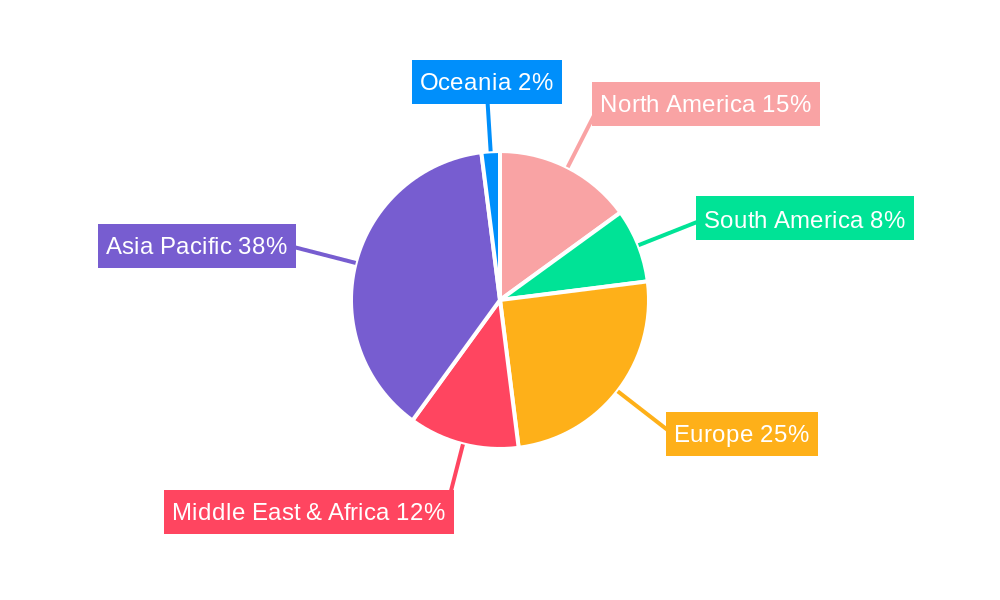
Hong Kong Cybersecurity Industry Regional Market Share
Geographic Coverage of Hong Kong Cybersecurity Industry
Hong Kong Cybersecurity Industry REPORT HIGHLIGHTS
| Aspects | Details |
|---|---|
| Study Period | 2020-2034 |
| Base Year | 2025 |
| Estimated Year | 2026 |
| Forecast Period | 2026-2034 |
| Historical Period | 2020-2025 |
| Growth Rate | CAGR of 9% from 2020-2034 |
| Segmentation |
|
Table of Contents
- 1. Introduction
- 1.1. Research Scope
- 1.2. Market Segmentation
- 1.3. Research Methodology
- 1.4. Definitions and Assumptions
- 2. Executive Summary
- 2.1. Introduction
- 3. Market Dynamics
- 3.1. Introduction
- 3.2. Market Drivers
- 3.2.1 Increasing Demand for Digitalization and Scalable IT Infrastructure; Need to tackle risks from various trends such as third-party vendor risks
- 3.2.2 the evolution of MSSPs
- 3.2.3 and adoption of cloud-first strategy
- 3.3. Market Restrains
- 3.3.1. Lack of Cybersecurity Professionals; High Reliance on Traditional Authentication Methods and Low Preparedness
- 3.4. Market Trends
- 3.4.1 Increasing Demand for Digitalization
- 3.4.2 Internet and Scalable IT Infrastructure drive the Hong Kong Cybersecurity Market
- 4. Market Factor Analysis
- 4.1. Porters Five Forces
- 4.2. Supply/Value Chain
- 4.3. PESTEL analysis
- 4.4. Market Entropy
- 4.5. Patent/Trademark Analysis
- 5. Global Hong Kong Cybersecurity Industry Analysis, Insights and Forecast, 2020-2032
- 5.1. Market Analysis, Insights and Forecast - by Offering
- 5.1.1. Security Type
- 5.1.1.1. Cloud Security
- 5.1.1.2. Data Security
- 5.1.1.3. Identity Access Management
- 5.1.1.4. Network Security
- 5.1.1.5. Consumer Security
- 5.1.1.6. Infrastructure Protection
- 5.1.1.7. Other Types
- 5.1.2. Services
- 5.1.1. Security Type
- 5.2. Market Analysis, Insights and Forecast - by Deployment
- 5.2.1. Cloud
- 5.2.2. On-premise
- 5.3. Market Analysis, Insights and Forecast - by End User
- 5.3.1. BFSI
- 5.3.2. Healthcare
- 5.3.3. Manufacturing
- 5.3.4. Government & Defense
- 5.3.5. IT and Telecommunication
- 5.3.6. Other End Users
- 5.4. Market Analysis, Insights and Forecast - by Region
- 5.4.1. North America
- 5.4.2. South America
- 5.4.3. Europe
- 5.4.4. Middle East & Africa
- 5.4.5. Asia Pacific
- 5.1. Market Analysis, Insights and Forecast - by Offering
- 6. North America Hong Kong Cybersecurity Industry Analysis, Insights and Forecast, 2020-2032
- 6.1. Market Analysis, Insights and Forecast - by Offering
- 6.1.1. Security Type
- 6.1.1.1. Cloud Security
- 6.1.1.2. Data Security
- 6.1.1.3. Identity Access Management
- 6.1.1.4. Network Security
- 6.1.1.5. Consumer Security
- 6.1.1.6. Infrastructure Protection
- 6.1.1.7. Other Types
- 6.1.2. Services
- 6.1.1. Security Type
- 6.2. Market Analysis, Insights and Forecast - by Deployment
- 6.2.1. Cloud
- 6.2.2. On-premise
- 6.3. Market Analysis, Insights and Forecast - by End User
- 6.3.1. BFSI
- 6.3.2. Healthcare
- 6.3.3. Manufacturing
- 6.3.4. Government & Defense
- 6.3.5. IT and Telecommunication
- 6.3.6. Other End Users
- 6.1. Market Analysis, Insights and Forecast - by Offering
- 7. South America Hong Kong Cybersecurity Industry Analysis, Insights and Forecast, 2020-2032
- 7.1. Market Analysis, Insights and Forecast - by Offering
- 7.1.1. Security Type
- 7.1.1.1. Cloud Security
- 7.1.1.2. Data Security
- 7.1.1.3. Identity Access Management
- 7.1.1.4. Network Security
- 7.1.1.5. Consumer Security
- 7.1.1.6. Infrastructure Protection
- 7.1.1.7. Other Types
- 7.1.2. Services
- 7.1.1. Security Type
- 7.2. Market Analysis, Insights and Forecast - by Deployment
- 7.2.1. Cloud
- 7.2.2. On-premise
- 7.3. Market Analysis, Insights and Forecast - by End User
- 7.3.1. BFSI
- 7.3.2. Healthcare
- 7.3.3. Manufacturing
- 7.3.4. Government & Defense
- 7.3.5. IT and Telecommunication
- 7.3.6. Other End Users
- 7.1. Market Analysis, Insights and Forecast - by Offering
- 8. Europe Hong Kong Cybersecurity Industry Analysis, Insights and Forecast, 2020-2032
- 8.1. Market Analysis, Insights and Forecast - by Offering
- 8.1.1. Security Type
- 8.1.1.1. Cloud Security
- 8.1.1.2. Data Security
- 8.1.1.3. Identity Access Management
- 8.1.1.4. Network Security
- 8.1.1.5. Consumer Security
- 8.1.1.6. Infrastructure Protection
- 8.1.1.7. Other Types
- 8.1.2. Services
- 8.1.1. Security Type
- 8.2. Market Analysis, Insights and Forecast - by Deployment
- 8.2.1. Cloud
- 8.2.2. On-premise
- 8.3. Market Analysis, Insights and Forecast - by End User
- 8.3.1. BFSI
- 8.3.2. Healthcare
- 8.3.3. Manufacturing
- 8.3.4. Government & Defense
- 8.3.5. IT and Telecommunication
- 8.3.6. Other End Users
- 8.1. Market Analysis, Insights and Forecast - by Offering
- 9. Middle East & Africa Hong Kong Cybersecurity Industry Analysis, Insights and Forecast, 2020-2032
- 9.1. Market Analysis, Insights and Forecast - by Offering
- 9.1.1. Security Type
- 9.1.1.1. Cloud Security
- 9.1.1.2. Data Security
- 9.1.1.3. Identity Access Management
- 9.1.1.4. Network Security
- 9.1.1.5. Consumer Security
- 9.1.1.6. Infrastructure Protection
- 9.1.1.7. Other Types
- 9.1.2. Services
- 9.1.1. Security Type
- 9.2. Market Analysis, Insights and Forecast - by Deployment
- 9.2.1. Cloud
- 9.2.2. On-premise
- 9.3. Market Analysis, Insights and Forecast - by End User
- 9.3.1. BFSI
- 9.3.2. Healthcare
- 9.3.3. Manufacturing
- 9.3.4. Government & Defense
- 9.3.5. IT and Telecommunication
- 9.3.6. Other End Users
- 9.1. Market Analysis, Insights and Forecast - by Offering
- 10. Asia Pacific Hong Kong Cybersecurity Industry Analysis, Insights and Forecast, 2020-2032
- 10.1. Market Analysis, Insights and Forecast - by Offering
- 10.1.1. Security Type
- 10.1.1.1. Cloud Security
- 10.1.1.2. Data Security
- 10.1.1.3. Identity Access Management
- 10.1.1.4. Network Security
- 10.1.1.5. Consumer Security
- 10.1.1.6. Infrastructure Protection
- 10.1.1.7. Other Types
- 10.1.2. Services
- 10.1.1. Security Type
- 10.2. Market Analysis, Insights and Forecast - by Deployment
- 10.2.1. Cloud
- 10.2.2. On-premise
- 10.3. Market Analysis, Insights and Forecast - by End User
- 10.3.1. BFSI
- 10.3.2. Healthcare
- 10.3.3. Manufacturing
- 10.3.4. Government & Defense
- 10.3.5. IT and Telecommunication
- 10.3.6. Other End Users
- 10.1. Market Analysis, Insights and Forecast - by Offering
- 11. Competitive Analysis
- 11.1. Global Market Share Analysis 2025
- 11.2. Company Profiles
- 11.2.1 iSystems Security Ltd*List Not Exhaustive
- 11.2.1.1. Overview
- 11.2.1.2. Products
- 11.2.1.3. SWOT Analysis
- 11.2.1.4. Recent Developments
- 11.2.1.5. Financials (Based on Availability)
- 11.2.2 IBM Corporation
- 11.2.2.1. Overview
- 11.2.2.2. Products
- 11.2.2.3. SWOT Analysis
- 11.2.2.4. Recent Developments
- 11.2.2.5. Financials (Based on Availability)
- 11.2.3 Rackspace Technology
- 11.2.3.1. Overview
- 11.2.3.2. Products
- 11.2.3.3. SWOT Analysis
- 11.2.3.4. Recent Developments
- 11.2.3.5. Financials (Based on Availability)
- 11.2.4 Maximus
- 11.2.4.1. Overview
- 11.2.4.2. Products
- 11.2.4.3. SWOT Analysis
- 11.2.4.4. Recent Developments
- 11.2.4.5. Financials (Based on Availability)
- 11.2.5 Ensign InfoSecurity Pte Ltd
- 11.2.5.1. Overview
- 11.2.5.2. Products
- 11.2.5.3. SWOT Analysis
- 11.2.5.4. Recent Developments
- 11.2.5.5. Financials (Based on Availability)
- 11.2.6 Edvance International Holdings Limited
- 11.2.6.1. Overview
- 11.2.6.2. Products
- 11.2.6.3. SWOT Analysis
- 11.2.6.4. Recent Developments
- 11.2.6.5. Financials (Based on Availability)
- 11.2.7 EIRE Systems K K
- 11.2.7.1. Overview
- 11.2.7.2. Products
- 11.2.7.3. SWOT Analysis
- 11.2.7.4. Recent Developments
- 11.2.7.5. Financials (Based on Availability)
- 11.2.8 Dual Layer IT Solutions LTD
- 11.2.8.1. Overview
- 11.2.8.2. Products
- 11.2.8.3. SWOT Analysis
- 11.2.8.4. Recent Developments
- 11.2.8.5. Financials (Based on Availability)
- 11.2.9 Digitpol
- 11.2.9.1. Overview
- 11.2.9.2. Products
- 11.2.9.3. SWOT Analysis
- 11.2.9.4. Recent Developments
- 11.2.9.5. Financials (Based on Availability)
- 11.2.10 Nexusguard
- 11.2.10.1. Overview
- 11.2.10.2. Products
- 11.2.10.3. SWOT Analysis
- 11.2.10.4. Recent Developments
- 11.2.10.5. Financials (Based on Availability)
- 11.2.1 iSystems Security Ltd*List Not Exhaustive
List of Figures
- Figure 1: Global Hong Kong Cybersecurity Industry Revenue Breakdown (undefined, %) by Region 2025 & 2033
- Figure 2: North America Hong Kong Cybersecurity Industry Revenue (undefined), by Offering 2025 & 2033
- Figure 3: North America Hong Kong Cybersecurity Industry Revenue Share (%), by Offering 2025 & 2033
- Figure 4: North America Hong Kong Cybersecurity Industry Revenue (undefined), by Deployment 2025 & 2033
- Figure 5: North America Hong Kong Cybersecurity Industry Revenue Share (%), by Deployment 2025 & 2033
- Figure 6: North America Hong Kong Cybersecurity Industry Revenue (undefined), by End User 2025 & 2033
- Figure 7: North America Hong Kong Cybersecurity Industry Revenue Share (%), by End User 2025 & 2033
- Figure 8: North America Hong Kong Cybersecurity Industry Revenue (undefined), by Country 2025 & 2033
- Figure 9: North America Hong Kong Cybersecurity Industry Revenue Share (%), by Country 2025 & 2033
- Figure 10: South America Hong Kong Cybersecurity Industry Revenue (undefined), by Offering 2025 & 2033
- Figure 11: South America Hong Kong Cybersecurity Industry Revenue Share (%), by Offering 2025 & 2033
- Figure 12: South America Hong Kong Cybersecurity Industry Revenue (undefined), by Deployment 2025 & 2033
- Figure 13: South America Hong Kong Cybersecurity Industry Revenue Share (%), by Deployment 2025 & 2033
- Figure 14: South America Hong Kong Cybersecurity Industry Revenue (undefined), by End User 2025 & 2033
- Figure 15: South America Hong Kong Cybersecurity Industry Revenue Share (%), by End User 2025 & 2033
- Figure 16: South America Hong Kong Cybersecurity Industry Revenue (undefined), by Country 2025 & 2033
- Figure 17: South America Hong Kong Cybersecurity Industry Revenue Share (%), by Country 2025 & 2033
- Figure 18: Europe Hong Kong Cybersecurity Industry Revenue (undefined), by Offering 2025 & 2033
- Figure 19: Europe Hong Kong Cybersecurity Industry Revenue Share (%), by Offering 2025 & 2033
- Figure 20: Europe Hong Kong Cybersecurity Industry Revenue (undefined), by Deployment 2025 & 2033
- Figure 21: Europe Hong Kong Cybersecurity Industry Revenue Share (%), by Deployment 2025 & 2033
- Figure 22: Europe Hong Kong Cybersecurity Industry Revenue (undefined), by End User 2025 & 2033
- Figure 23: Europe Hong Kong Cybersecurity Industry Revenue Share (%), by End User 2025 & 2033
- Figure 24: Europe Hong Kong Cybersecurity Industry Revenue (undefined), by Country 2025 & 2033
- Figure 25: Europe Hong Kong Cybersecurity Industry Revenue Share (%), by Country 2025 & 2033
- Figure 26: Middle East & Africa Hong Kong Cybersecurity Industry Revenue (undefined), by Offering 2025 & 2033
- Figure 27: Middle East & Africa Hong Kong Cybersecurity Industry Revenue Share (%), by Offering 2025 & 2033
- Figure 28: Middle East & Africa Hong Kong Cybersecurity Industry Revenue (undefined), by Deployment 2025 & 2033
- Figure 29: Middle East & Africa Hong Kong Cybersecurity Industry Revenue Share (%), by Deployment 2025 & 2033
- Figure 30: Middle East & Africa Hong Kong Cybersecurity Industry Revenue (undefined), by End User 2025 & 2033
- Figure 31: Middle East & Africa Hong Kong Cybersecurity Industry Revenue Share (%), by End User 2025 & 2033
- Figure 32: Middle East & Africa Hong Kong Cybersecurity Industry Revenue (undefined), by Country 2025 & 2033
- Figure 33: Middle East & Africa Hong Kong Cybersecurity Industry Revenue Share (%), by Country 2025 & 2033
- Figure 34: Asia Pacific Hong Kong Cybersecurity Industry Revenue (undefined), by Offering 2025 & 2033
- Figure 35: Asia Pacific Hong Kong Cybersecurity Industry Revenue Share (%), by Offering 2025 & 2033
- Figure 36: Asia Pacific Hong Kong Cybersecurity Industry Revenue (undefined), by Deployment 2025 & 2033
- Figure 37: Asia Pacific Hong Kong Cybersecurity Industry Revenue Share (%), by Deployment 2025 & 2033
- Figure 38: Asia Pacific Hong Kong Cybersecurity Industry Revenue (undefined), by End User 2025 & 2033
- Figure 39: Asia Pacific Hong Kong Cybersecurity Industry Revenue Share (%), by End User 2025 & 2033
- Figure 40: Asia Pacific Hong Kong Cybersecurity Industry Revenue (undefined), by Country 2025 & 2033
- Figure 41: Asia Pacific Hong Kong Cybersecurity Industry Revenue Share (%), by Country 2025 & 2033
List of Tables
- Table 1: Global Hong Kong Cybersecurity Industry Revenue undefined Forecast, by Offering 2020 & 2033
- Table 2: Global Hong Kong Cybersecurity Industry Revenue undefined Forecast, by Deployment 2020 & 2033
- Table 3: Global Hong Kong Cybersecurity Industry Revenue undefined Forecast, by End User 2020 & 2033
- Table 4: Global Hong Kong Cybersecurity Industry Revenue undefined Forecast, by Region 2020 & 2033
- Table 5: Global Hong Kong Cybersecurity Industry Revenue undefined Forecast, by Offering 2020 & 2033
- Table 6: Global Hong Kong Cybersecurity Industry Revenue undefined Forecast, by Deployment 2020 & 2033
- Table 7: Global Hong Kong Cybersecurity Industry Revenue undefined Forecast, by End User 2020 & 2033
- Table 8: Global Hong Kong Cybersecurity Industry Revenue undefined Forecast, by Country 2020 & 2033
- Table 9: United States Hong Kong Cybersecurity Industry Revenue (undefined) Forecast, by Application 2020 & 2033
- Table 10: Canada Hong Kong Cybersecurity Industry Revenue (undefined) Forecast, by Application 2020 & 2033
- Table 11: Mexico Hong Kong Cybersecurity Industry Revenue (undefined) Forecast, by Application 2020 & 2033
- Table 12: Global Hong Kong Cybersecurity Industry Revenue undefined Forecast, by Offering 2020 & 2033
- Table 13: Global Hong Kong Cybersecurity Industry Revenue undefined Forecast, by Deployment 2020 & 2033
- Table 14: Global Hong Kong Cybersecurity Industry Revenue undefined Forecast, by End User 2020 & 2033
- Table 15: Global Hong Kong Cybersecurity Industry Revenue undefined Forecast, by Country 2020 & 2033
- Table 16: Brazil Hong Kong Cybersecurity Industry Revenue (undefined) Forecast, by Application 2020 & 2033
- Table 17: Argentina Hong Kong Cybersecurity Industry Revenue (undefined) Forecast, by Application 2020 & 2033
- Table 18: Rest of South America Hong Kong Cybersecurity Industry Revenue (undefined) Forecast, by Application 2020 & 2033
- Table 19: Global Hong Kong Cybersecurity Industry Revenue undefined Forecast, by Offering 2020 & 2033
- Table 20: Global Hong Kong Cybersecurity Industry Revenue undefined Forecast, by Deployment 2020 & 2033
- Table 21: Global Hong Kong Cybersecurity Industry Revenue undefined Forecast, by End User 2020 & 2033
- Table 22: Global Hong Kong Cybersecurity Industry Revenue undefined Forecast, by Country 2020 & 2033
- Table 23: United Kingdom Hong Kong Cybersecurity Industry Revenue (undefined) Forecast, by Application 2020 & 2033
- Table 24: Germany Hong Kong Cybersecurity Industry Revenue (undefined) Forecast, by Application 2020 & 2033
- Table 25: France Hong Kong Cybersecurity Industry Revenue (undefined) Forecast, by Application 2020 & 2033
- Table 26: Italy Hong Kong Cybersecurity Industry Revenue (undefined) Forecast, by Application 2020 & 2033
- Table 27: Spain Hong Kong Cybersecurity Industry Revenue (undefined) Forecast, by Application 2020 & 2033
- Table 28: Russia Hong Kong Cybersecurity Industry Revenue (undefined) Forecast, by Application 2020 & 2033
- Table 29: Benelux Hong Kong Cybersecurity Industry Revenue (undefined) Forecast, by Application 2020 & 2033
- Table 30: Nordics Hong Kong Cybersecurity Industry Revenue (undefined) Forecast, by Application 2020 & 2033
- Table 31: Rest of Europe Hong Kong Cybersecurity Industry Revenue (undefined) Forecast, by Application 2020 & 2033
- Table 32: Global Hong Kong Cybersecurity Industry Revenue undefined Forecast, by Offering 2020 & 2033
- Table 33: Global Hong Kong Cybersecurity Industry Revenue undefined Forecast, by Deployment 2020 & 2033
- Table 34: Global Hong Kong Cybersecurity Industry Revenue undefined Forecast, by End User 2020 & 2033
- Table 35: Global Hong Kong Cybersecurity Industry Revenue undefined Forecast, by Country 2020 & 2033
- Table 36: Turkey Hong Kong Cybersecurity Industry Revenue (undefined) Forecast, by Application 2020 & 2033
- Table 37: Israel Hong Kong Cybersecurity Industry Revenue (undefined) Forecast, by Application 2020 & 2033
- Table 38: GCC Hong Kong Cybersecurity Industry Revenue (undefined) Forecast, by Application 2020 & 2033
- Table 39: North Africa Hong Kong Cybersecurity Industry Revenue (undefined) Forecast, by Application 2020 & 2033
- Table 40: South Africa Hong Kong Cybersecurity Industry Revenue (undefined) Forecast, by Application 2020 & 2033
- Table 41: Rest of Middle East & Africa Hong Kong Cybersecurity Industry Revenue (undefined) Forecast, by Application 2020 & 2033
- Table 42: Global Hong Kong Cybersecurity Industry Revenue undefined Forecast, by Offering 2020 & 2033
- Table 43: Global Hong Kong Cybersecurity Industry Revenue undefined Forecast, by Deployment 2020 & 2033
- Table 44: Global Hong Kong Cybersecurity Industry Revenue undefined Forecast, by End User 2020 & 2033
- Table 45: Global Hong Kong Cybersecurity Industry Revenue undefined Forecast, by Country 2020 & 2033
- Table 46: China Hong Kong Cybersecurity Industry Revenue (undefined) Forecast, by Application 2020 & 2033
- Table 47: India Hong Kong Cybersecurity Industry Revenue (undefined) Forecast, by Application 2020 & 2033
- Table 48: Japan Hong Kong Cybersecurity Industry Revenue (undefined) Forecast, by Application 2020 & 2033
- Table 49: South Korea Hong Kong Cybersecurity Industry Revenue (undefined) Forecast, by Application 2020 & 2033
- Table 50: ASEAN Hong Kong Cybersecurity Industry Revenue (undefined) Forecast, by Application 2020 & 2033
- Table 51: Oceania Hong Kong Cybersecurity Industry Revenue (undefined) Forecast, by Application 2020 & 2033
- Table 52: Rest of Asia Pacific Hong Kong Cybersecurity Industry Revenue (undefined) Forecast, by Application 2020 & 2033
Frequently Asked Questions
1. What is the projected Compound Annual Growth Rate (CAGR) of the Hong Kong Cybersecurity Industry?
The projected CAGR is approximately 9%.
2. Which companies are prominent players in the Hong Kong Cybersecurity Industry?
Key companies in the market include iSystems Security Ltd*List Not Exhaustive, IBM Corporation, Rackspace Technology, Maximus, Ensign InfoSecurity Pte Ltd, Edvance International Holdings Limited, EIRE Systems K K, Dual Layer IT Solutions LTD, Digitpol, Nexusguard.
3. What are the main segments of the Hong Kong Cybersecurity Industry?
The market segments include Offering, Deployment, End User.
4. Can you provide details about the market size?
The market size is estimated to be USD XXX N/A as of 2022.
5. What are some drivers contributing to market growth?
Increasing Demand for Digitalization and Scalable IT Infrastructure; Need to tackle risks from various trends such as third-party vendor risks. the evolution of MSSPs. and adoption of cloud-first strategy.
6. What are the notable trends driving market growth?
Increasing Demand for Digitalization. Internet and Scalable IT Infrastructure drive the Hong Kong Cybersecurity Market.
7. Are there any restraints impacting market growth?
Lack of Cybersecurity Professionals; High Reliance on Traditional Authentication Methods and Low Preparedness.
8. Can you provide examples of recent developments in the market?
April 2022- HCL Technologies (HCL), one of the leading global technology company, announced the expansion of its strategic collaboration with Microsoft to provide robust security capabilities to clients globally. HCL Technologies has earned all four advanced security specialties offered to Microsoft partners. These specializations demonstrate Microsoft partners' ability to offer specialized security services in challenging solutions using Azure.
9. What pricing options are available for accessing the report?
Pricing options include single-user, multi-user, and enterprise licenses priced at USD 3800, USD 4500, and USD 5800 respectively.
10. Is the market size provided in terms of value or volume?
The market size is provided in terms of value, measured in N/A.
11. Are there any specific market keywords associated with the report?
Yes, the market keyword associated with the report is "Hong Kong Cybersecurity Industry," which aids in identifying and referencing the specific market segment covered.
12. How do I determine which pricing option suits my needs best?
The pricing options vary based on user requirements and access needs. Individual users may opt for single-user licenses, while businesses requiring broader access may choose multi-user or enterprise licenses for cost-effective access to the report.
13. Are there any additional resources or data provided in the Hong Kong Cybersecurity Industry report?
While the report offers comprehensive insights, it's advisable to review the specific contents or supplementary materials provided to ascertain if additional resources or data are available.
14. How can I stay updated on further developments or reports in the Hong Kong Cybersecurity Industry?
To stay informed about further developments, trends, and reports in the Hong Kong Cybersecurity Industry, consider subscribing to industry newsletters, following relevant companies and organizations, or regularly checking reputable industry news sources and publications.
Methodology
Step 1 - Identification of Relevant Samples Size from Population Database



Step 2 - Approaches for Defining Global Market Size (Value, Volume* & Price*)

Note*: In applicable scenarios
Step 3 - Data Sources
Primary Research
- Web Analytics
- Survey Reports
- Research Institute
- Latest Research Reports
- Opinion Leaders
Secondary Research
- Annual Reports
- White Paper
- Latest Press Release
- Industry Association
- Paid Database
- Investor Presentations

Step 4 - Data Triangulation
Involves using different sources of information in order to increase the validity of a study
These sources are likely to be stakeholders in a program - participants, other researchers, program staff, other community members, and so on.
Then we put all data in single framework & apply various statistical tools to find out the dynamic on the market.
During the analysis stage, feedback from the stakeholder groups would be compared to determine areas of agreement as well as areas of divergence